
The wheel turns again — not with a crash or a blaze, but with a low, steady breath. Winter still holds the land in its grip, yet something has shifted. The days are lengthening, the light returns by minutes, and beneath frozen ground the first signs of life are already stirring.
This is Imbolc — the festival of thresholds, milk, flame, and promise. It is not spring, but it is the knowledge that spring will come.
Marked halfway between the Winter Solstice and the Spring Equinox, Imbolc stands at the quiet hinge of the year. The fields are still bare, the nights still cold, but the darkness is no longer winning. A fire has been lit.
WHEN IS IMBOLC?

Unlike solstices and equinoxes, Imbolc is a cross-quarter festival, meaning it isn’t tied to a precise astronomical event but to the felt rhythm of the season. Some observe it on:
-
February 1st (most common in contemporary Pagan practice) is also St Brigid’s feast day.
-
February 2nd, influenced by Christian Candlemas, which absorbed earlier Imbolc customs
-
Or the astronomical cross-quarter point, the exact midpoint between the winter solstice (Yule) and spring equinox (Ostara), which can land late on February 3rd or early February 4th.
Within the pagan Wheel of the Year, Imbolc marks the first real movement away from winter’s stillness. The fire lit here is not a bonfire — it’s a hearth flame, a candle, a spark kept alive against the cold.
HOW OLD IS IMBOLC, REALLY?
Imbolc is often described as an ancient festival stretching back into deep prehistory — sometimes even to the Neolithic period. While this idea is appealing, the reality is more complicated.
Historically, Imbolc appears as one of four major seasonal markers observed by Gaelic communities, rather than one of the eight festivals of the modern Wheel of the Year. That eightfold structure is a much later development, shaped by 20th-century Paganism rather than early medieval calendars. What we can say with confidence is that Imbolc marked an important seasonal turning point, tied to the beginning of spring in the practical, agricultural sense.
Our earliest firm evidence for Imbolc as a named festival in Ireland dates to around the 10th century. Anything earlier than that remains speculative. This does not mean the observance itself was new at that time, but it does mean we should be cautious about assigning it a fixed, prehistoric origin.
One common assumption is that Imbolc must be Neolithic because it aligns with agrarian life. But agriculture alone does not automatically place a tradition in the Neolithic. Across Europe, agrarian societies existed under very different social, economic, and religious systems, often separated by thousands of years. Even the Neolithic period itself did not occur uniformly across the continent.
There is also the question of calendars. The earliest known European calendars were lunar, not solar, and the first signs of spring vary widely from year to year depending on climate and region. This makes it unlikely that Imbolc was initially tied to a rigid calendar date in the way modern observances often are. It was more likely responsive — observed when conditions suggested the land was beginning to shift.
Across Europe, there are hundreds of similar seasonal celebrations, known by different names and held on different dates, but shaped by the same practical concerns: livestock coming back into cycle, preparation of the soil, the slow return of daylight, and the need to endure the last hard stretch of winter. Some of these traditions are genuinely pre-Christian; others emerged much later, during the Christian Middle Ages or even the early modern period, shaped by political, economic, and social pressures.
What is consistent is that, in the Northern Hemisphere, Imbolc marks the midpoint between the Winter Solstice and the Spring Equinox.
It is less important whether Imbolc belongs to an idealised pagan past than that it developed within animistic agrarian societies responding to real conditions. Climate, land, and survival shaped these observances, which were less concerned with myth and more with managing a fragile dependence on forces beyond human control.
WHAT DOES IMBOLC MEAN?
Some connect the name to ideas of cleansing, often tied to fire or practical land-management practices such as burning fields to prepare them for growth. Others, and many scholars in particular, favour an origin in the Old Irish i mbolg, meaning “in the belly,” most likely a reference to pregnant livestock. This reading is widely used today, though it reflects economic reality as much as spiritual symbolism. Whichever way you read it, Imbolc connects to new beginnings.
It was the season when ewes began to lactate, when milk returned to the table, and when people could finally see evidence that the year was turning in their favour. Survival still wasn’t guaranteed — but hope was no longer abstract.
MARK THE RETURNING LIGHT WITH OUR SOWILO RUNE BOOKMARK — A SIMPLE REMINDER THAT THE SUN IS GAINING STRENGTH AGAIN, PAGE BY PAGE.
FIRE AND WATER: THE TWO POWERS OF IMBOLC
Imbolc is shaped by two elemental forces that appear, at first glance, to oppose one another: fire and water. In reality, they work together, mirroring the quiet tension of the season itself. Winter has not released its hold, yet the thaw has begun. The land is cold, but it is no longer lifeless.
FIRE
Fire is the most visible symbol of Imbolc — not the wild blaze of midsummer, but the steadfast flame that survives winter.
At this time of year, fire means:
-
Candles and hearths kept burning against the cold
-
Smith fires, where tools are repaired and prepared for the year ahead
-
Light returns day by day as the sun’s strength slowly grows.
Fire brings warmth, but it also demands skill and intention. In a forge, it has to be carefully tended: too weak and nothing takes shape, too hot and everything is ruined. This makes fire the perfect symbol for Imbolc’s deeper message of discipline and perseverance.
Spiritually, fire governs inspiration, creativity, and will. It is the inner spark that urges action after months of stillness. At Imbolc, this spark is small but vital. It does not demand immediate results — only commitment to tending it.
This is why candles feature so strongly in Imbolc rites. Each flame stands in defiance of the dark, a reminder that light does not return all at once. It is earned slowly.
WATER
If fire is Imbolc’s promise, water is its proof.
Sacred wells and springs have long been associated with Imbolc. Across Ireland and the wider Celtic world, wells dedicated to Brigid (more on her shortly) were visited at this time for healing, blessing, and protection. These waters were believed to carry the land’s memory — ancient, restorative, and deeply tied to place.
Water at Imbolc appears in many forms:
-
Holy wells and springs, linked to healing and oath-making
-
Milk, as livestock begin to lactate again after winter scarcity
-
Snowmelt, soaking back into the earth and feeding future growth.
Water cleanses, but it also nourishes what cannot yet be seen. Beneath frozen soil, roots begin to wake, seeds soften, and life stirs in the darkness and damp, long before any green breaks the surface. Snowdrops are often associated with Imbolc as the first flower of the year to bloom, even amid frost or snow.
Milk holds special significance here too — a bridge between water and nourishment, between survival and renewal. Its return marked a turning point in the agricultural year, a sign that the worst of winter could be endured.
IMBOLC AND BRIGID: THE POET, THE HEALER AND THE SMITH

No figure is more closely tied to Imbolc than Brigid — among the most enduring figures of the Celtic world. Her associations with fire, poetry, healing, smithcraft, fertility, and water point toward a broader function. She presides over the forge and the hearth, the well and the birthing bed.
In the early Irish sources, particularly the Lebor Gabála Érenn (The Book of Invasions), Brigid is described as a daughter of the Dagda, chief of the Tuatha Dé Danann. She is sometimes presented as threefold — or as three sisters sharing one name — reflecting her dominion over three intertwined arts:
-
Brigid the Poet, patron of inspiration, song, memory, and sacred speech
-
Brigid the Healer, keeper of wells, herbs, and restorative knowledge
-
Brigid the Smith, guardian of fire, craft, and the shaping of tools and weapons.
This triplicity is more about completeness than separation. Poetry, healing, and smithcraft were not seen as unrelated skills — all required mastery, intuition, and the ability to transform one thing into another. A blade, a cure, and a poem were all acts of making.
Brigid’s link to fire runs deep, but it isn’t just about warmth. The hearth fire kept a household alive through winter, the forge fire repaired and shaped the tools people relied on, and the inner fire of inspiration mattered in a culture where history, law, and belief were carried by memory and storytelling. Tending fire was everyday work, but it was also how a community kept itself going.

Just as important are Brigid’s wells and springs. Across Ireland, many still carry her name. Long before Christianity, people visited these places for healing, to make vows, or simply to show respect and rest in quiet contemplation. Water mattered because it worked — cleaning, softening the soil, and sustaining life beneath frozen ground. At this point in the year, it carried equal weight to fire.
When Christianity spread through Ireland, Brigid did not disappear — and this is perhaps the clearest testament to her importance. Instead, she became Saint Brigid of Kildare, one of Ireland’s most beloved saints. The transition is so seamless that it is often impossible to say where the goddess ends and the saint begins.
As Saint Brigid of Kildare, she inherited many of the goddess Brigid’s defining qualities. A flame was kept burning in her honour at Kildare, tended by women. Stories were told of her healing, blessings of good fortune, and protection of cattle and dairy — the everyday concerns that meant survival in an agrarian world. She was also remembered for her insistence on hospitality and care for the poor, reflecting the older belief that the hearth carried a responsibility to feed and shelter those in need.

Her feast day, February 1st, falls at the time Imbolc celebrations always have, allowing the older seasonal marker to continue within the Christian calendar. The Brigid’s Cross, woven from rushes and placed in homes, closely resembles earlier protective charms tied to fertility and blessing.
This was a deliberate choice to preserve something essential by allowing it to change form.
Imbolc customs around Brigid also show just how animistic these traditions really were. In many places, she wasn’t honoured at a distance; she was invited in. At Imbolc, households prepared a bed for her, laid out rushes or reeds, and left everyday objects out in the hope that she would pass through and bless them. Goddess or saint, it made little difference. Brigid was treated as a presence that could arrive, move through the house, and leave something behind.
This wasn’t uniquely pagan, and it wasn’t uniquely Christian either. Similar practices survived in Catholic communities across Europe well into the modern period, in which statues or images were brought into the home at particular times of year to receive hospitality and to offer protection in return. What’s at work here isn’t superstition, but an efficient kind of animism — the understanding that relationships with unseen forces are maintained through simple acts of care, attention, and welcome.
Most modern historians agree that Saint Brigid was very likely a real 5th–6th-century abbess associated with Kildare, but her story was later mythologised and blended with traits of the pre-Christian goddess Brigid. Early medieval Christianity in Ireland often absorbed older sacred figures rather than erasing them, and Brigid is the clearest example of this process. So while the saint probably existed as a historical religious leader, many of her miracles (abundance, healing, protection, and sacred fire), symbols, and even aspects of her feast day reflect continuity with the older goddess. In other words: a real woman, remembered through a mythic lens shaped by much older belief systems.

This tiny vellum fragment from the Abbey of Saint-Maurice d’Agaune in Switzerland contains what may be the earliest surviving written mention of St Brigid, dating to around 700 AD. Written in Insular script and listing Brigid alongside her successor abbess and bishop at Kildare, the fragment shows that Irish monasteries were sending saints’ relics across Europe far earlier than previously assumed. Although the relics themselves are lost, the label is strong evidence of early Irish religious networks on the Continent and pilgrimage routes through the Alps.
THE CAILLEACH: WINTER’S HOLD AND THE QUESTION OF RELEASE

Alongside Brigid, Imbolc is also tied to another, older figure — the Cailleach, the winter hag, the stone-faced keeper of cold, storm, and endurance.
Where Brigid announces the return of light, the Cailleach represents what remains to be overcome.
In Gaelic tradition, the Cailleach is not a villain, nor a symbol of decay. She is winter itself — ancient, powerful, and necessary. She shapes the land through frost and storm, governs the dark half of the year, and controls how long winter will last. Mountains, stones, and rough landscapes are often attributed to her hand, thrown or shaped as she moves across the land.
Imbolc sits at a point of tension in her cycle.
According to later folk tradition, Imbolc is the day the Cailleach goes out to gather firewood to see her through the rest of winter. If the weather is fair and bright, it means she has succeeded — winter will linger. If the day is foul, stormy, or dark, it suggests she has failed to gather enough, and winter’s end is near.
This weather lore is sometimes treated lightly today, but it reflects a deeper truth: good weather at Imbolc was not always good news. A bright, calm day could signal a longer stretch of cold still to come. A harsh one meant winter was breaking its own grip.
In some traditions, the Cailleach eventually relinquishes her power, turning to stone or passing authority to Brigid as the year shifts. This transition is not a defeat, but a necessary handover. Winter does not end because it is destroyed, but because its work is done.
THE CAILLEACH, SKAÐI AND ANGRBOÐA: PARALLELS ACROSS THE NORTH
If you’ve spent any time with Norse mythology, the Cailleach can feel oddly familiar. She’s often compared to Skaði, and at a glance, the comparison makes sense. Both are tied to cold places — mountains, snow, hard ground — and both treat winter not as a season of decline, but as something that endures. Something that has its own authority.
Neither figure is soft-edged or ornamental. They belong to landscapes where survival depends on experience and restraint — knowing when to act and when to wait. Skaði is mobile and self-reliant, moving through the mountains on skis with a bow, very much at home in the high, frozen places. The Cailleach is heavier, slower, and older. She doesn’t pass through the land — she makes it, raising stone, shaping hills, and holding the seasons in balance.
But Skaði isn’t the only Norse figure worth mentioning here. A closer functional parallel to the Cailleach appears in Angrboða, an ancient giantess who stands outside the order of the gods altogether. Angrboða belongs to an older layer of myth — one associated with endings, winter, and forces the Æsir cannot tame or fully understand. The surviving sources tell us very little about her, but what remains suggests something important: she represents a power that predates order and survives its attempts at control.
That’s where the real connection lies. These figures don’t share a common origin so much as a shared role. Cultures living with long, brutal winters tended to imagine that season as a presence — sometimes active, sometimes immovable, but always formidable. Winter wasn’t something to be defeated. It was something to be endured, respected, and lived alongside.
Seen this way, the similarities between the Cailleach, Skaði, and Angrboða say less about myths borrowing from one another and more about people responding to the same realities of climate and landscape. Different traditions, different stories — but the same understanding that winter shapes the world, and those who survive it.
NORSE AND HEATHEN PARALLELS: DISTING AND DISABLOT
The Norse world didn’t mark Imbolc by name, but it recognised the same point in the year. In late winter, observances such as Dísablót or Disting were held in honour of the dísir — female ancestral and divine figures linked to protection, fertility, and fate.
These rites were rooted in the household and the family line. They were about making sure both fields and people remained fertile as the year began to shift. The symbolism isn’t the same as Imbolc’s, but the timing and purpose line up closely. This was a point in the year when attention turned to the quieter forces at work — the ones you don’t see, but rely on all the same — guiding life through its most fragile, uncertain stage.
It’s a valuable reminder that seasonal awareness wasn’t unique to one culture or belief system. Across the north, marking this point in the year was less about theology and more about necessity — an acknowledgement of where life stood, and what it would take to carry it forward.
IMBOLC IN MODERN PAGAN PRACTICE

In modern Pagan and Wiccan practice, Imbolc is usually seen as a time for clearing out, resetting, and preparing for the months ahead. It’s common to light candles to mark the returning strength of the sun, to tidy and clear both your space and your head, and to set intentions or begin projects that will grow as the year unfolds.
Many people also honour Brigid at this time, particularly in her roles as a source of inspiration, healing, and protection. More than anything, Imbolc is about beginning gently — deciding what you’re willing to care for in the months ahead, and letting everything else fall away.
SIMPLE WAYS TO HONOUR IMBOLC TODAY
You don’t need an elaborate ritual to mark Imbolc. In fact, the season has never really asked for one. This is a quiet turning — better acknowledged through small, deliberate acts than spectacle.
Lighting a single candle at dusk is often enough, not as a ceremony, just as a way of marking the moment. A small flame held against the evening dark reflects what the season itself is doing. It doesn’t end winter, but it makes it clear that its hold is no longer absolute.
Imbolc has also long been a time for cleaning and mending. Clearing one room, one shelf, or one neglected corner is very much in keeping with older custom. This wasn’t about purity in the abstract, but readiness — making sure what you already have is in working order before anything new arrives.
Some people choose this time to name a skill they want to refine over the coming year. Not a grand reinvention, just something practical like learning, repairing, practising, or improving.
Of course, visiting a spring, stream, or well — even symbolically — echoes the older practice of returning to places where life continues quietly beneath the surface.
Food matters here as well. Cooking something warm and simple, with care, fits the season better than any feast. This is hearth time, not harvest.
In keeping with older Brigid traditions, some still leave a strip of cloth, ribbon, or a scarf — known variously as a Brat Bríde, Brat Bhríde, Bratóg Bhríde, Ribín Bhríde or Brigid’s Cloak — out overnight on the eve of Brigid’s feast (January 31st), pinned in a closed window, tied to a gate, hung on a bush or doorstep so that it could be touched and blessed as Brigid passed through. Red and white are traditional colours for the cloth, but use matters more than appearance.

A QUIET IMBOLC RITUAL (STEP-BY-STEP)
Purpose: To acknowledge winter’s hold, welcome returning light, and set a steady intention for growth.
Timing: Evening, January 31st or February 1st or 2nd
Duration: 20–30 minutes
WHAT YOU’LL NEED
-
One candle (white or natural wax)
-
A bowl of water or milk
-
A small piece of paper and a pen
-
(Optional) a small cloth, ribbon, or strip of fabric.
1. STILL THE SPACE
Dim the lights. Sit comfortably. Breathe slowly. Let the day settle.
2. LIGHT THE CANDLE
Say (or think): “In the depth of winter, the light returns.”
If you wish to address Brigid directly, you can add: “Brigid of the hearth and well, be welcome.”
No invocation is required — naming is enough.
3. CLEANSE
Dip your fingers into the water or milk and touch your brow or your hands. This isn’t about purification in the abstract, just a physical reset.
4. SET INTENTION
Write one thing you wish to nurture or learn in the coming year. Keep it practical. Imbolc favours steady work over ambition.
5. A SIMPLE BRIGID GESTURE (OPTIONAL)
If you’ve brought a piece of cloth or ribbon, take a moment to hold it and then place it beside the candle. This echoes the older Brat Bríde custom, but as a quiet acknowledgement of how things used to be done, and that Brigid hasn’t been forgotten. When the ritual is done, pin or tie it outside at a window, gate, or door, and leave it there to meet the turning of the year.
6. CLOSE
Extinguish the candle with thanks. Fold the paper and keep it somewhere safe. You don’t need to burn it, as this ritual is not about letting go, but about tending and nurturing.
That’s enough. Truly.
READING RUNES AT IMBOLC
Rune work at Imbolc tends to be quieter than at other points in the year. This isn’t a season for big questions or sweeping predictions. It’s better suited to asking what needs tending, rather than what is about to happen.
If runes are used at all, a single-rune draw makes more sense than a spread. Imbolc is about beginnings held in reserve, and one symbol is often enough to point toward what requires patience, care, or steady attention.
Read plainly. At Imbolc, runes aren’t offering answers so much as instructions — where to focus, what to maintain, and what not to rush. Like the season itself, the message is usually simple: something has begun. Your task is to carry it carefully until it can stand on its own.
IMBOLC IS A GOOD TIME TO WORK SLOWLY AND DELIBERATELY. OUR RUNE READER BUNDLE — RUNE STONES, A RUNIC NOTEBOOK, AND RUNES, SIGILS & BIND RUNES — IS MADE FOR THAT KIND OF ATTENTION.
IMBOLC SYMBOLISM AND TATTOO THEMES
Imbolc imagery tends to be subtle — and that’s where its strength lies. This is not a season of full colour or dramatic contrast. It’s about what’s beginning quietly, often out of sight, and the symbols that fit it carry that same restraint.
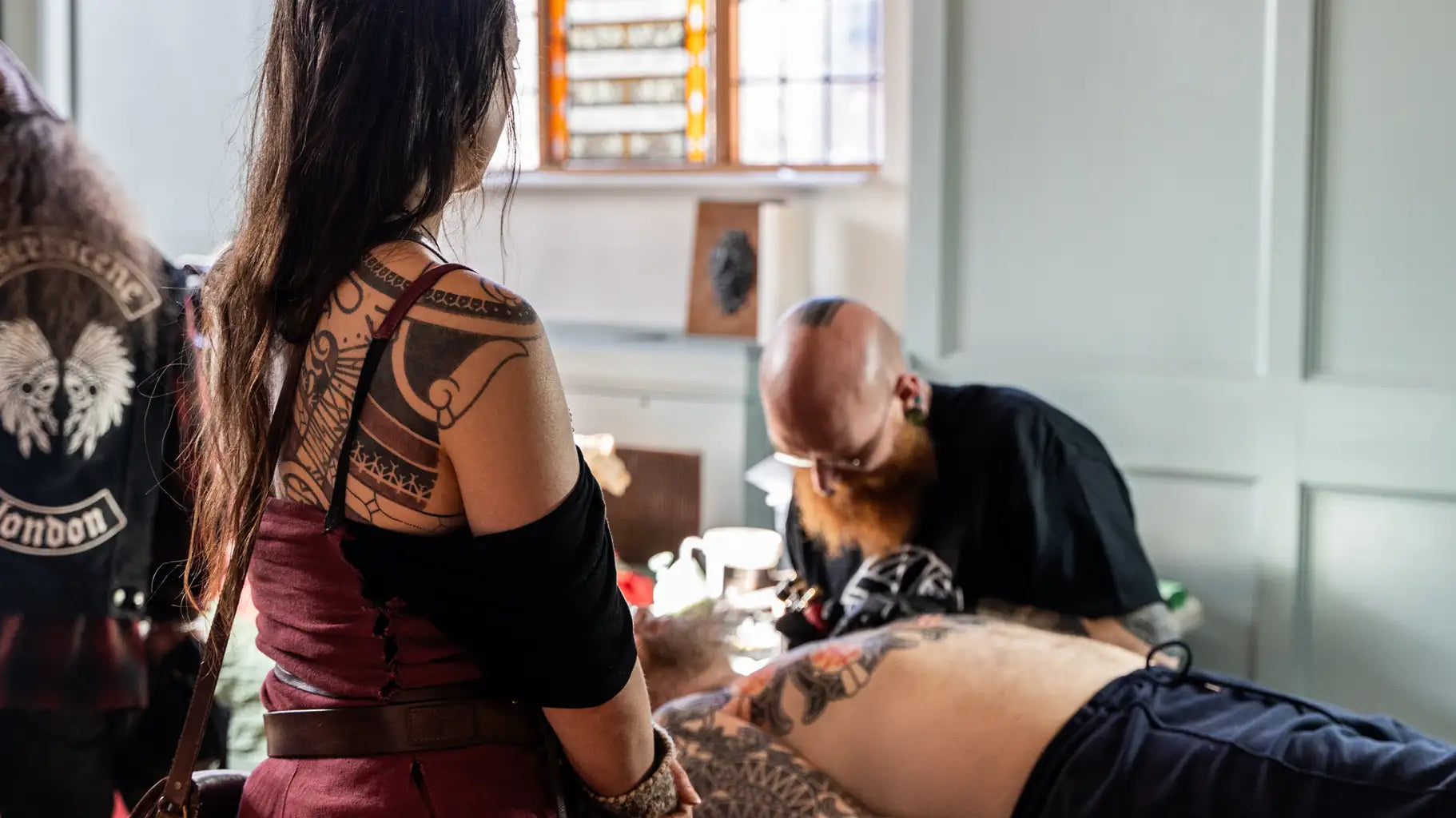
As with other points on the Wheel of the Year, Imbolc lends itself to imagery that works well in body art. Tattoos, after all, are a way of marking the skin in response to time and change — much like the seasonal marks left on the land itself.

-
Fire motifs: For Imbolc, fire works best when it’s restrained. Single candles, small flames, sun sigils, all work well.
-
Water symbols: Wells, cups, thin flowing lines, or simple wave forms translate well into tattoo work and echo Brigid’s springs.
-
Early growth imagery: Snowdrops, buds, shoots, or bare branches with just a hint of growth fit Imbolc far better than anything in full leaf. These images carry the idea of beginnings without needing to announce them.
-
Woven and crafted forms: Brigid’s Cross, rushwork patterns, interlace, or restrained knotwork sit naturally on the body. They speak to protection, domestic craft, and the value of making something useful — themes that hold up long after the season has passed.
-
Tools and craft symbols: anvils, hammers, forge marks, or even scar-like lines suggesting repair rather than decoration connect directly to Brigid’s association with skilled work and transformation.
-
Runes: Berkano (ᛒ), linked to sheltered growth, Ingwaz (ᛝ), associated with potential held in reserve, and Jera (ᛃ), which marks the turning of the cycle, can all carry Imbolc meaning without relying on obvious seasonal imagery. Sowilo (ᛋ) (the sun as a life-giving, guiding force) would have been another contender, but unfortunately, its use by the Third Reich has made it a tattoo symbol that is difficult to get away with in modern times.
-
Triple Goddess motifs: threefold symbols, repeated forms, or quiet references to cycles can be used to hold Brigid and the Cailleach together, not as separate figures, but as different faces of the same seasonal process: youth, maturity, and age; growth, endurance, and release.
For those who follow a Celtic or Heathen path, an Imbolc-inspired tattoo does not need to be obvious. It may simply carry the season’s themes — preparation, return, and careful attention — into a design that holds personal significance. Like the festival itself, Imbolc tattoos tend to work best when they are restrained. Less declaration, more promise.
TENDING TO IMBOLC
Across its many strands — Brigid and the hearth, wells and water, runes read quietly, tools repaired rather than replaced — Imbolc returns again and again to the same idea: tending. Tending fire. Tending skill. Tending relationships with land, season, and the forces that lie beyond easy control. Nothing here is rushed. Nothing is declared finished.
This is why Imbolc endures. It doesn’t offer transformation on demand, but recognises that renewal begins quietly, in preparation rather than celebration, and in the decision to keep tending what has already started.
HONOUR IMBOLC AND THE RETURNING LIGHT WITH TOOLS ROOTED IN THE OLD WAYS — EXPLORE OUR RUNES, BOOKS, HOMEWARE AND APPAREL.