
If you spend enough time around Norse tattoos, you start to notice a pattern. The same creatures come back again and again.
Wolves, ravens, serpents, bears. Often a horse. Sometimes a boar. Something with too many limbs or not quite the right shape. That’s because these animals were never just animals. They were tied to gods, to death, to the structure of the world itself. Some walked beside the Æsir. Others gnawed at the roots of existence. Some would bring about the end of everything.
In Norse mythology, animals are not symbolic in the modern sense; they are active participants. So if you are thinking of getting a tattoo of one of these lovely beasties, it’s best to learn about their story and symbolism.
THE NORSE VIEW OF ANIMALS
The Norse world is not human-centred. Gods, giants, animals, and the dead all exist within the same structure — connected through Yggdrasil, the world tree.
Animals move through this structure freely:
-
Between worlds
-
Between states of being
-
Between life and death.
This is why so many creatures in Norse myth feel larger than they should be. They are not really representations of nature, though they can be. They are part of the machinery of reality.
WOLVES IN NORSE MYTHOLOGY

COMPANIONS, DESTROYERS, AND THE INEVITABILITY OF FATE
Wolves in Norse mythology are not just animals. They are thresholds.
They sit at the boundary between order and chaos, between control and collapse. Sometimes they are trusted. Sometimes they are feared. Often, they are both at once.
Unlike modern symbolism — where wolves are reduced to loyalty, strength, or “pack mentality” — Norse wolves are more unstable. They are forces that can stand beside the gods, or destroy them, and that duality is the point.
WHAT WOLVES REPRESENT
Across the surviving myths and cultural traces, wolves tend to carry a few consistent ideas:
-
Hunger — not just physical, but existential
-
Inevitability — the sense that something is coming, and cannot be stopped
-
Liminality — existing between categories (tamed/untamed, ally/enemy)
-
Disruption of order — especially when systems try to contain what cannot be contained
Wolves are not “evil” in a moral sense. They are pressure.
NOTABLE WOLVES IN NORSE MYTH
FENRIR — BOUND POWER AND THE COST OF FEAR
Fenrir is the most well-known wolf in Norse mythology, and for good reason.
He is the son of Loki and the giantess Angrboða, and brother to Jörmungandr and Hel. Unlike his siblings, Fenrir is brought into Asgard and raised by the gods.
That decision defines everything that follows.
As he grows, the gods become afraid of him — not because of what he has done, but because of what he is foretold to do. They attempt to bind him with chains. He breaks them. Eventually, they turn to Gleipnir, a ribbon made from impossible things — the sound of a cat’s footsteps, the roots of mountains, the breath of a fish — absences, things that leave no trace. It succeeds where strength fails.
Fenrir agrees to be bound only if one of the gods places a hand in his mouth. Týr does. When the binding holds, to absolutely nobody’s surprise, Fenrir bites his hand off. From that moment, there is no trust left between them.
At Ragnarök, Fenrir kills Odin.
WHAT FENRIR REPRESENTS
Fenrir is not just destruction. He represents:
-
Defiance against imposed limits
-
The inevitability of becoming what others fear
-
Power that cannot be contained without consequence.
It is one of the few Norse symbols that reflects as much on the gods as it does on the creature.
This shirt shows Fenrir eating a fascist. It’s a clear message against hate and a show of support for the Trans community.
GERI AND FREKI — LOYALTY WITHOUT ILLUSION
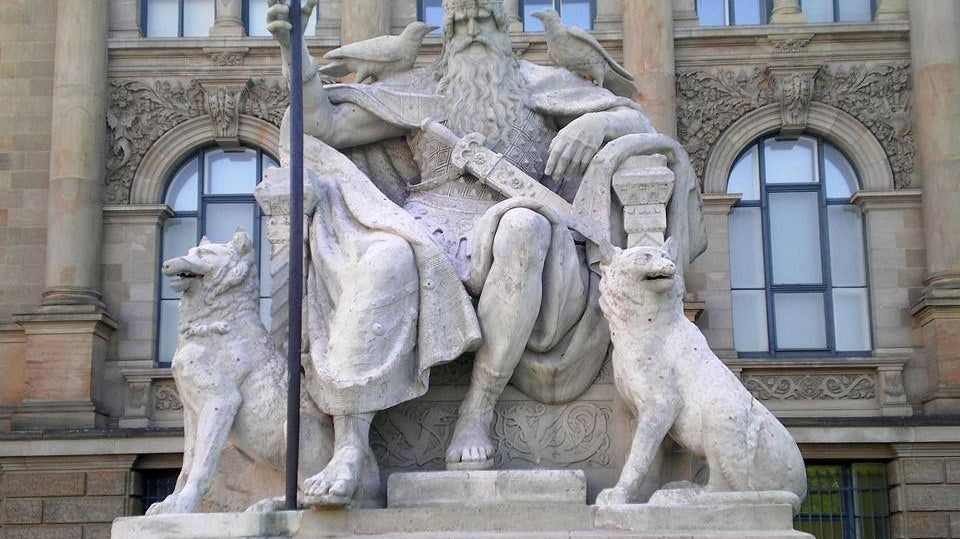
Geri and Freki are Odin’s wolves. They sit beside him in Valhalla, fed meat from his table while he consumes only wine. They are rarely described in detail, suggesting they were familiar figures that did not need explanation.
Unlike Fenrir, they are not disruptive; they are part of the family.
WHAT THEY REPRESENT
-
Controlled strength
-
Loyalty without sentimentality
-
The presence of violence held in check, not removed.
SKÖLL AND HATI — THE END OF TIME IN MOTION
Sköll and Hati are wolves that chase the sun and moon across the sky. They are always pursuing, always just behind. Until they are not. At Ragnarök, they catch their prey, and the order of the world collapses.
WHAT THEY REPRESENT
-
Time as something hunted
-
The inevitability of endings
-
The constant approach of change.
WOLVES IN ARCHAEOLOGY AND NORSE ART

Wolf imagery is less dominant than serpents in surviving Norse art, but it does appear — and when it does, it tends to be deliberate.
You can find wolf or wolf-like figures in:
-
The Torslunda Plates (Sweden, ~6th–7th century) — These are bronze die plates believed to have been used to decorate helmets. One plate shows a figure wearing what appears to be a wolf or animal head, possibly in a ritual or martial context.
-
Gotland Picture Stones (Sweden, Viking Age) — These carved stones often depict scenes from myth, including what many scholars interpret as Fenrir devouring Odin.
-
Oseberg Tapestry Fragments (Norway, ~9th century) — Fragmentary textiles from the famous Oseberg ship burial include processions of animals and figures — some interpreted as wolves or wolf-like creatures.
-
Urnes Style Carvings (Norway, ~11th century) — The Urnes style is dominated by long, interlaced animals — often serpentine, but sometimes interpreted as wolves or hybrid beasts.
Some interpretations of berserker imagery also suggest wolf-warrior associations alongside bear cults, though this remains debated.
Unlike serpents, wolves are rarely used as structural design elements. They are more often figures or characters in a story.
WOLVES IN NORSE TATTOOING TODAY
Modern Norse wolf tattoos tend to fall into two categories:
ARCHETYPAL WOLVES
Large, realistic or stylised wolves representing strength, independence, or identity. These often draw more from modern symbolism than Norse sources.
MYTH-SPECIFIC WOLVES
Fenrir, or occasionally Sköll and Hati, are depicted in narrative or symbolic scenes. These carry more direct links to the original material.
Wolf imagery is one of the most commonly used in modern Norse tattooing, but it’s also one of the most misunderstood.
If you want something closer to the original material, our 28 Norse Wolf Designs PDF offers a more grounded starting point — 28 designs shaped by Norse symbolism and visual style, rather than modern reinterpretation.
NB: This is a digital download, not a hard copy booklet.
RAVENS IN NORSE MYTHOLOGY

THOUGHT, MEMORY, AND THE WEIGHT OF WHAT IS KNOWN
Ravens are among the most recognisable animals in Norse mythology. But unlike wolves — which shift between roles — ravens are more precise.
In a world where knowledge is never complete and never safe, ravens sit close to the centre of power — not because they control anything, but because they see.
WHAT RAVENS REPRESENT
Across the myths and surviving cultural traces, ravens tend to carry:
-
Thought and memory — the internal processes that shape understanding
-
Observation — seeing without acting
-
Knowledge gathering — movement across the world to bring information back
-
Presence in death — not as killers, but as witnesses.
NOTABLE RAVENS IN NORSE MYTH
HUGINN AND MUNINN — THOUGHT AND MEMORY
The two most well-known ravens are Huginn (“Thought”) and Muninn (“Memory”), who belong to Odin.
Each day, they fly across the world and return to him with what they have seen. This is not a casual detail — it is central to how Odin operates. He does not rely on strength alone; he gathers knowledge. And it’s always useful to have two extra pairs of eyes when you have only a single eyeball of your own.
In the Poetic Edda (Grímnismál), Odin speaks directly about them:
He fears that Huginn may not return — but he fears more for Muninn.
That distinction matters. Thought can wander and return. Memory, once lost, does not come back the same. Together, they form something close to awareness itself.
WHAT THEY REPRESENT
Huginn and Muninn are not just messengers.
They represent:
-
The relationship between thinking and remembering
-
The fragility of knowledge
-
The idea that perception is always incomplete.
They are extensions of Odin — but not fully under his control.
RAVENS BEYOND ODIN — WAR, DEATH, AND PRESENCE
Ravens are not limited to Huginn and Muninn. They appear more broadly in Norse culture, particularly in relation to war.
In real life, ravens followed conflict. They fed on the dead. This gave them a dual identity:
-
Practical scavengers
-
Symbols of aftermath and witness.
In skaldic poetry, ravens are often used as shorthand for battle: A “feast for ravens” meant a battlefield filled with the fallen.
THE RAVEN BANNER
Several historical sources describe Viking leaders carrying a raven banner.
The most well-known references come from The Anglo-Saxon Chronicle and accounts of figures like Ivar the Boneless and other Norse leaders. These banners were believed to be linked to Odin. In some accounts, the raven on the banner would appear to move or flap in the wind, and this was taken as a sign of favour or impending victory.
RAVENS IN ARCHAEOLOGY AND NORSE ART

Ravens appear more clearly in the archaeological record than wolves. They are not always labelled, but their form is recognisable.
You can find raven or raven-like figures in:
-
The Vendel and Valsgärde Helmet Plates (Sweden, ~6th–8th century) — These richly decorated helmet plates often depict birds alongside warriors and mythic scenes. Some are interpreted as ravens, particularly where they appear in association with figures believed to represent Odin or elite warriors.
-
Gotland Picture Stones (Sweden, Viking Age) — These carved stones frequently show narrative scenes involving riders, ships, and battle imagery. Birds appearing above or beside figures are often interpreted as ravens, especially in contexts linked to Odin or the journey of the dead.
-
The Raven Banner (Referenced in Anglo-Saxon sources, ~9th–11th century) — While no complete original survives, written accounts describe Viking banners bearing a raven symbol associated with Odin. These banners were said to move or come alive in the wind, signalling victory or divine favour.
-
Borre and Jellinge Style Metalwork (Scandinavia, ~9th–10th century) — Decorative metal objects such as brooches and fittings sometimes include stylised bird forms. These are often highly abstract, but some are interpreted as ravens within broader interlaced animal designs.
RAVENS IN NORSE TATTOOING TODAY
Ravens are one of the most commonly tattooed Norse animals — but they are often simplified.
PAIRED RAVENS (HUGINN & MUNINN)
-
Symmetrical designs
-
Often placed on the chest, shoulders, or forearms
-
Sometimes accompanied by runes or Odin imagery.
SINGLE RAVEN
-
More naturalistic or illustrative
-
Often tied to themes of death, battle, or solitude.
INTERLACED RAVEN DESIGNS
-
Inspired by Urnes or Borre styles
-
More historically grounded
-
Less immediately recognisable, but more accurate.
If you’re looking at raven tattoos seriously, it’s worth spending time with designs that are actually rooted in the source material, rather than modern interpretations layered on top.
Our 28 Norse Raven Designs were put together with that in mind — a collection of raven forms drawn from Norse art styles and mythological context, designed to give you something closer to the original language of these creatures. Note: This is a downloadable PDF, not a physical book.
SERPENTS, DRAGONS, AND WYRMS IN NORSE MYTHOLOGY

CYCLES, BOUNDARIES, AND THE SLOW UNDOING OF THINGS
If wolves represent disruption, serpents represent structure. Not stable structure — but structure under tension.
They bind the world, define its edges, and quietly wear it down over time. They are not sudden forces. They are continuous ones.
In Norse mythology, serpents and serpent-like creatures are rarely incidental.
They are placed carefully:
-
Around the world
-
Beneath it
-
Within it.
They do not arrive to cause chaos. They are already there.
WHAT SERPENTS REPRESENT
Across myth, poetry, and visual culture, serpents tend to carry:
-
Cycles and enclosure — things that loop, return, and repeat
-
Boundaries — edges of worlds, limits of human reach
-
Decay and erosion — not destruction in a single act, but over time
-
Transformation — especially when tied to greed, power, or isolation.
They are not always enemies, but they are never neutral.
NOTABLE SERPENTS, DRAGONS, AND WYRMS
JÖRMUNGANDR — THE WORLD ENCIRCLED

Jörmungandr, the Midgard Serpent, is one of the most structurally important beings in Norse cosmology. He is the second child of Loki and the giantess Angrboða, born alongside Fenrir and Hel. Cast into the sea by Odin, he grows and grows. Until eventually, he becomes so vast that he encircles the entire world, lying in the ocean with his body forming a complete ring, his tail held in his own mouth. This image defines the boundary of Midgard — the limit of the human world, held in place by a living, coiled force.
His most well-known encounter comes through Thor, and it does not happen in battle, but during a fishing trip. Thor, accompanied by the giant Hymir, uses an ox’s head as bait and casts his line into the deep. When Jörmungandr takes it, Thor begins to haul him up from the ocean. For a moment, they face each other.
Thor, the defender of the gods. Jörmungandr, the boundary of the world. It is a meeting that feels final, but is not allowed to be.
Before Thor can strike, Hymir — fearing what will happen if the serpent is fully brought ashore — cuts the line. Jörmungandr sinks back into the depths, and the confrontation is deferred.
At Ragnarök, the two meet again, this time without interruption. Thor kills Jörmungandr, but the victory is not clean. After striking the serpent down, he walks nine steps before collapsing, overcome by its venom.
WHAT JÖRMUNGANDR REPRESENTS
-
Cyclical existence
-
Containment and boundary
-
The idea that ending something has a cost.
If you’re drawn to serpent forms, it’s often because of that sense of enclosure — something that does not just exist within the world, but defines its edges. Designs inspired by Jörmungandr tend to convey that feeling most clearly, especially when the form closes in on itself, forming a complete, unbroken loop.
NÍÐHÖGGR — THE GNAWING BELOW
While Jörmungandr defines the outer boundary of the world, Níðhöggr exists beneath it, at the roots of Yggdrasil.
He is typically described as a serpent or dragon-like creature — not clearly one or the other, but something older, less defined. In the Poetic Edda, he is said to dwell in Niflheim, among the deepest roots of the world tree, where he gnaws constantly at its base.
In some accounts, he also consumes the bodies of the dead — particularly those guilty of grave wrongdoing — reinforcing his connection to decay, punishment, and the breakdown of order.
Níðhöggr does not end the world in a single act. He weakens it over time.
WHAT NÍÐHÖGGR REPRESENTS
-
A quieter, more persistent form of danger
-
The idea that collapse often begins out of sight
-
Endurance — but in a destructive sense.
FÁFNIR — THE SHAPE OF GREED
Fáfnir is often called a dragon, but, like many creatures in Norse myth, he does not start out that way. He is the son of the dwarf king Hreiðmarr and originally not monstrous at all.
His transformation begins with gold.
After Loki kills the dwarf Ótr, the gods are forced to pay compensation in gold — including a cursed ring taken from the dwarf Andvari. This treasure carries with it a destructive influence, though it is not always described as a simple “curse.”
Fáfnir kills his own father to claim it. He then withdraws from the world, taking the hoard with him and guarding it alone. Over time, he changes. Not suddenly, not through a spell cast upon him — but gradually, through what he becomes.
He turns into a dragon. He becomes a monster through greed, possession, and isolation.
He is eventually slain by Sigurd, who digs a pit along the path to Fáfnir’s lair and strikes from below as the dragon passes overhead. Even then, the story does not resolve cleanly — the treasure remains cursed, and its consequences continue beyond Fáfnir’s death.
WHAT FÁFNIR REPRESENTS
-
A warning against excess and obsession
-
The cost of valuing wealth over connection
-
The idea that becoming monstrous is a process, not an event.
SERPENTINE FORMS IN ARCHAEOLOGY AND NORSE ART

If you are looking for one animal that defines Norse art, it is the serpent. They are everywhere.
-
The Jelling Stone (Denmark, ~10th century) — One of the most famous Viking Age monuments, raised by King Harald Bluetooth. The stone features a large interlaced beast, often interpreted as a serpent or dragon, wrapped around the runic inscription. The body of the creature forms part of the composition, reinforcing the idea of serpents as both container and boundary.
-
The Ramsund Carving (Sweden, ~11th century) — This rock carving depicts the story of Sigurd and Fáfnir. The dragon is shown stretched across the scene, pierced from below, with its long body framing the narrative. It is one of the clearest visual representations of Fáfnir in Norse art.
-
The Urnes Stave Church Carvings (Norway, ~11th–12th century) — The Urnes style is defined by long, slender, interwoven animals, most commonly interpreted as serpents. These creatures twist, loop, and grip each other in continuous motion, creating a flowing, almost endless pattern that directly influences modern Norse tattoo design.
- Oseberg Ship Carvings (Norway, ~9th century) — The Oseberg burial includes intricately carved woodwork with animal ornamentation. While many figures are hybrid or ambiguous, serpent-like forms appear within the flowing decorative panels, blending into a broader visual language of interlaced beasts.
SERPENTS, WYRM, AND DRAGONS IN NORSE TATTOOING TODAY
Serpents and dragon-like forms are among the most structurally faithful designs in Norse tattooing — but even here, meaning can be lost if they are treated as generic fantasy creatures rather than part of a larger system.
WRAPPING SERPENTS (JÖRMUNGANDR-INSPIRED)
-
Designed to coil around the body — arms, legs, or full torso
-
Often circular or enclosed in composition
-
Reflect themes of cycles, boundaries, and containment
INTERLACED SERPENT DESIGNS
-
Inspired by Urnes, Borre, or Jellinge art styles
-
Built from flowing, continuous lines that loop and bind
-
More historically grounded
-
Less literal, but closer to how serpents appear in Norse artefacts.
DRAGON FORMS (FÁFNIR-INSPIRED)
-
Larger, more illustrative pieces
-
Often show a full creature rather than a pattern
-
Tied to themes of transformation, greed, and isolation.
STRUCTURAL RUNESTONE DESIGNS
-
Serpents used as frames or carriers for runes
-
The body of the creature forms the inscription line
-
Reflects the idea of meaning contained within a living form.
HYBRID AND ABSTRACT BEASTS
-
Blended forms that are not clearly serpent, dragon, or animal
-
Common in Viking Age art
-
More symbolic than literal
-
Often overlooked, but among the most historically accurate.
If you’re drawn to serpent or dragon tattoos, it’s worth looking beyond modern fantasy interpretations and back toward how these forms were actually used in Norse art.
The Wyrms and Dragons PDF – Norse Serpent Designs brings together 28 designs on digital download, built from that older visual language — interlaced bodies, coiling structures, and forms that feel closer to the way serpents were used to frame, bind, and define.
OTHER ANIMALS AND CREATURES IN NORSE MYTHOLOGY
PRESENCE, FUNCTION, AND THE QUIETER PARTS OF THE WORLD
Not every creature in Norse mythology sits at the centre of a cosmic event.
Some do not encircle the world. Some do not bring about Ragnarök. But they are still there. Moving between spaces, supporting systems, marking transitions.
These animals help complete the structure — filling in the spaces between gods, giants, and the larger forces already discussed.
NOTABLE ANIMALS AND CREATURES
SLEIPNIR — THE ONE THAT CROSSES BETWEEN WORLDS

Sleipnir, Odin’s horse, is one of the strangest and most important creatures in Norse myth.
He has eight legs and, of course, is another child of Loki, who, in one of the more unusual stories, takes the form of a mare and gives birth to him.
Sleipnir is not just a mount; he is a means of passage. Odin rides him between worlds — between the living and the dead, between realms that are otherwise difficult to reach.
WHAT SLEIPNIR REPRESENTS
-
Movement between worlds
-
The ability to cross boundaries that others cannot
-
The connection between life, death, and knowledge.
GULLINBURSTI — THE GOLDEN BOAR

Gullinbursti is the boar of Freyr, crafted by dwarves and said to shine with golden light.
He can run through air and water faster than any horse, and his presence is tied closely to fertility, prosperity, and the land itself.
Boars in Norse culture were not passive animals. They were powerful, dangerous, and associated with both war and abundance.
WHAT BOARS REPRESENT
-
Fertility and growth
-
Strength tied to the land
-
Wealth that is active, not stored.
HEIÐRÚN — SUSTENANCE WITHOUT END
Heiðrún is a goat that stands atop Valhalla, feeding on the leaves of Yggdrasil. From her udders flows an endless supply of mead, sustaining the warriors of the afterlife.
This is not excess for its own sake. It is continuity — the idea that some systems do not run out.
WHAT HEIÐRÚN REPRESENTS
-
Renewal and ongoing provision
-
Sustenance tied to the structure of the world
-
Cycles that continue without depletion.
TANNGRISNIR AND TANNGNJÓSTR — DESTRUCTION AND RETURN

Thor’s goats, Tanngrisnir and Tanngnjóstr, pull his chariot.
He kills and eats them — then resurrects them the next day, provided their bones remain intact. This is one of the clearest examples of cyclical destruction and renewal in Norse myth.
WHAT THEY REPRESENT
-
Consumption without loss
-
The cycle of death and return
-
Power that restores itself.
THE SKOGKATT — THE FOREST CAT

Cats are most often associated with Freya, whose chariot is pulled by large felines — sometimes referred to in later tradition as skogkatt (forest cats).
They are not heavily detailed in early sources, but their presence is consistent enough to matter. Unlike wolves or serpents, they are not tied to destruction or boundaries; they are more about magical feline prowess, much like Freya.
WHAT CATS REPRESENT
-
Independence
-
Subtle power
-
Association with Freyja, fertility, and magic.
GARMR — THE HOUND OF HEL
Garmr is a hound associated with the realm of the dead.
He is often described as chained, guarding Hel, and at Ragnarök, he breaks free and fights the god Týr. He is sometimes compared to Fenrir, though smaller in scale.
WHAT GARMR REPRESENTS
-
Guardianship of the dead
-
Thresholds between life and death
-
Contained violence.
RATATOSKR — THE ONE WHO CARRIES WORDS

Ratatoskr is the squirrel that runs up and down Yggdrasil, carrying insults between the eagle at the top and Níðhöggr at the roots.
This detail is easy to dismiss, but it serves a function. It maintains tension. It keeps conflict alive.
WHAT RATATOSKR REPRESENTS
-
Communication without resolution
-
The persistence of conflict
-
Movement between levels of the world.
A 17th century Icelandic manuscript depicting Ratatoskr chewing on Yggdrasil.
THE STAGS OF YGGDRASIL — DÁINN, DVALINN, DUNEYRR, DURAÞRÓR
Four stags feed on the leaves of Yggdrasil. They are rarely expanded upon, but their presence is consistent. They consume the tree, just as Níðhöggr gnaws at its roots.

WHAT THEY REPRESENT
-
Consumption within the system
-
The idea that even sustaining structures are worn down
-
Balance through ongoing use.
ROOSTERS — THE SIGNAL OF THE END

Several roosters appear in the myths, most notably Gullinkambi, who crows to signal the beginning of Ragnarök.
Others crow in different realms, marking the same moment across the structure of the world.
WHAT ROOSTERS REPRESENT
-
Announcement and transition
-
The marking of time
-
The beginning of irreversible change.
If you’re exploring these lesser-known creatures for tattoo inspiration, it’s worth approaching them the same way as the more recognisable figures — not as standalone symbols, but as part of a wider system.
They may not sit at the centre of the story, but they help hold it together.
THE BEAST BENEATH THE SKIN
These animals were never just decorations and they were never meant to be simple. Wolves that stand beside gods and destroy them, ravens that carry thought and memory but never fully belong, serpents that both bind the world and quietly undo it — each one holds multiple meanings at once.
Modern interpretations tend to flatten them into something easy: strength, wisdom, danger. But in Norse mythology, nothing is that clean. These creatures are not fixed symbols; they are processes — shifting, contradictory, and shaped by context. That complexity is exactly why they endure. They reflect something recognisable in the human experience — tension, change, uncertainty, and growth — which is why, if you look closely enough, there is almost certainly something here that resonates with you and makes you want to wear it on your skin permanently.
EXPLORE OUR BOOKS, APPAREL, HOMEWARE AND RUNES ROOTED IN NORSE TRADITION — DESIGNED WITH RESPECT FOR THE PAST.