
A while back, I made a video about Viking tattoos you should not get. It went down well. Perhaps too well, because a significant number of you came back and pointed out, quite reasonably, that I never tell you what you should get. Fair point. So here it is: seven historically grounded Viking Age tattoo designs that are worth your skin.
This is not a definitive list. It is a starting point, built from genuine historical sources, from artefacts I have spent years studying and drawing from. Each of these designs has archaeological backing. Each of them has depth. And each of them, in the right hands, makes for a remarkable tattoo.
Let the list begin.
1. WOLVES
One of the most requested designs in my studio. People love wolves, and with good reason. They are extraordinary animals: solitary and yet profoundly social, capable of both tenderness and ferocity in the same creature.
In Norse mythology, wolves occupy a unique position. They are simultaneously allies and enemies of the gods. They appear as companions, as cosmic threats, as symbols of the warrior spirit. The Úlfhéðnar, elite Norse warriors who were said to embody the wolf, drew on this dual nature deliberately. And then there is Fenrir, the great wolf bound beneath the world, whose eventual freedom will play a Major role in Ragnarök itself.
HISTORICAL SOURCES
The beauty of wolves as a tattoo subject is that the historical record is rich. Two standout examples worth knowing:
The St. Paul's Cathedral wolf in London is carved in the Ringerike style: fluid, elegant, full of tension. It is one of the finest surviving examples of Norse animal art found in England and translates brilliantly into large-scale tattoo work. As you can see, it even comes with a pet!
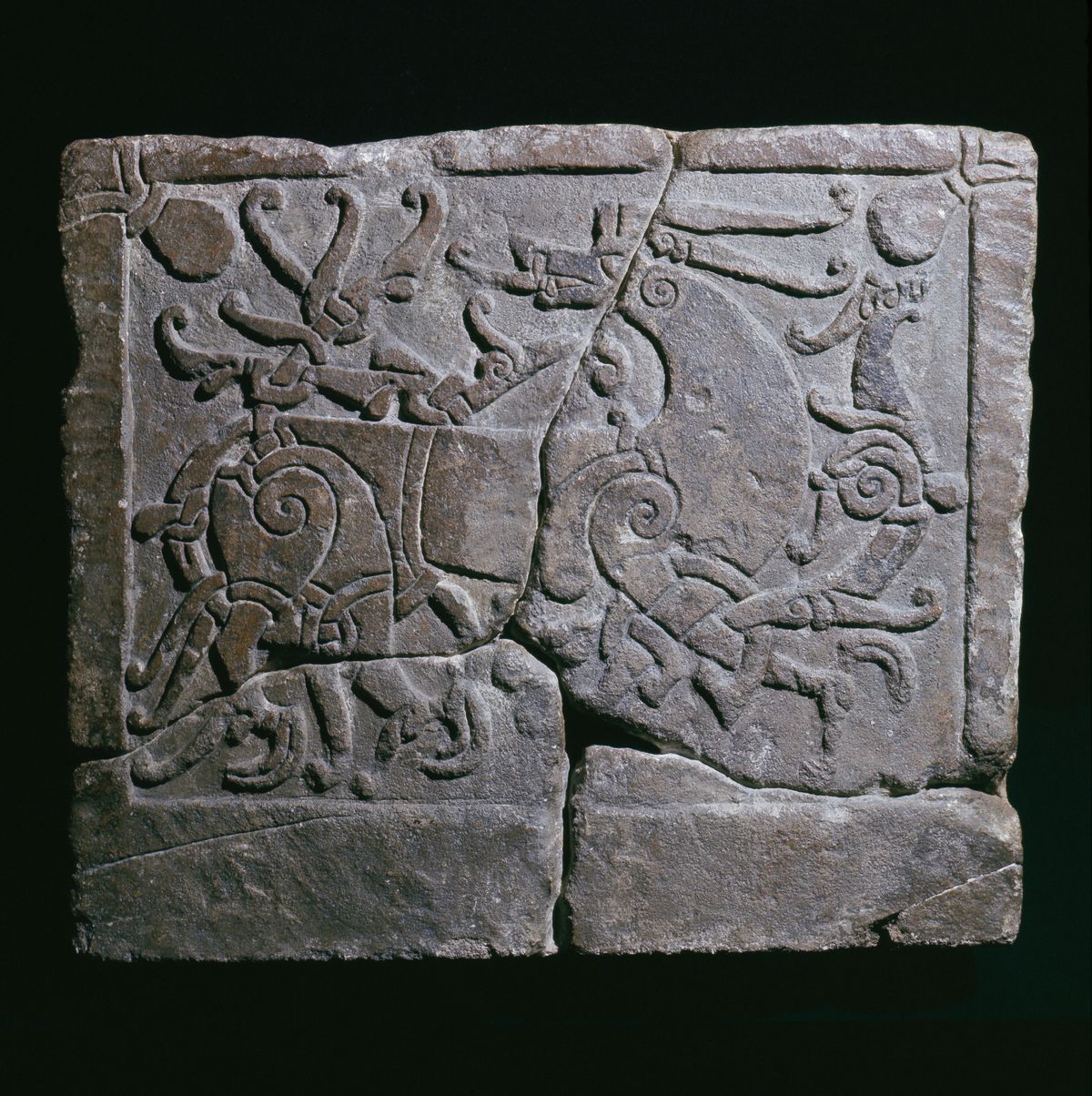
Heritage Image Partnership Ltd / Alamy
On the Bamberg Casket, there are animal depictions that most scholars read as wolves. Again, Ringerike style. This item is decorated in the Mammen style. Powerful, coiling forms built for perfect integration into body art.
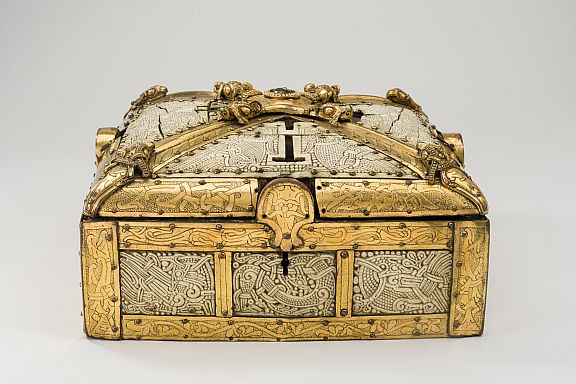
CC BY-NC-ND 4.0
Both are beautiful points of departure. Both are beautiful and workable examples. If you want something with genuine historical weight, this is a good starting point for learning. start here.
2. THOR'S HAMMER (MJOLNIR)
Thor's hammer is one of the most widespread symbols of the Viking Age. Not in the way that people currently use it on social media. Genuinely, archaeologically widespread. Mjolnir pendants have been found in hundreds of graves across Scandinavia, England, Germany, and beyond. There are even casting moulds discovered that suggest they were mass-produced. This was not a fringe symbol. It was a statement, worn openly.
Thor´s hammer is one of the most widespread symbols and items of the Viking age. It is a genuine symbol of pagan faith, it is deeply tied to the culture and belief of the Scandinavians, but was not only found in graves within Scandinavia, but also in England, Germany and well beyond. Aside from the Mjolnir hammer itself, several casting moulds of soapstone have been found, showing them to have been so common that they were mass-produced. They were not a fringe symbol; they were a statement of belonging, worn openly and proudly.
There have been hundreds of Thor´s hammers found, but not only that, there are myriad different designs, from simple iron hammers to beautiful and elaborate gold-filigree hammers, adorned with additional designs and, on occasion, with runes.
And should one doubt that the form symbolises the hammer of Thor, there is even an example with a runic inscription reading “Hammer”!
WHAT IT MEANS
According to the mythology, Mjolnir is the weapon that keeps the forces of chaos at bay. Thor wields it in defence of both gods and humans. The hammer's short handle, explained in the stories as the result of interference during its forging, only adds to its character. It is a flawed tool that still destroys everything it needs to.
Beyond mythology, it was worn as a clear sign of allegiance to the old faith, particularly in territories where Christianity was advancing. Wearing a Thor's hammer was, in many cases, a deliberate act of cultural and religious defiance. That meaning still carries weight today. There are several examples of Thor´s hammers with an added cross, as well as a cross-pendant with a hammer-like shape, which is theorised to have been used to maintain the old faith, while nodding and accepting Christian rulership
RECOMMENDED EXAMPLES
Two specific hammers are worth studying closely. The Rømersdal style Thor's hammer from Denmark. This is the one I have tattooed on myself. Beautifully proportioned, with a character that holds up at any scale. The Bredsätra hammer from Sweden is another remarkable example, sadly believed to be lost, though renditions survive. Take time to study both before you bring them to a tattoo artist,
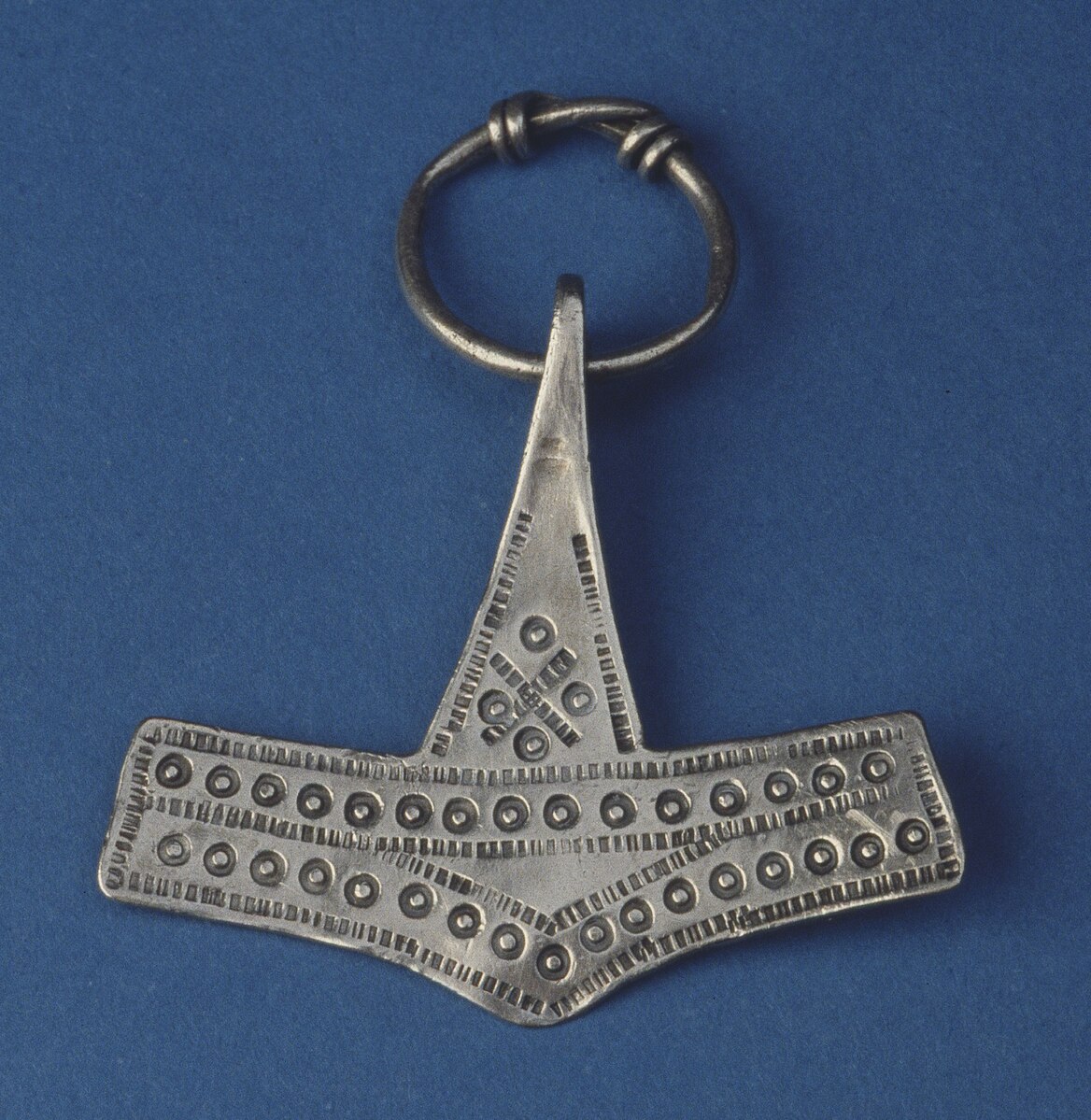
Thor's hammer from Rømersdal, probably silver votive/deposit, photograph by Arnold Mikkelsen, c. 790-1100.

CC BY 4.0
3. GODMASKS
Godmasks (also known as Grylemasks) are among the most striking and least understood images in Viking Age art. Strange, powerful faces appear on ship fittings, jewellery, stones, and weapons throughout the archaeological record. We do not have written sources that clearly explain them. What we have is the objects themselves, and they are remarkable.
WHAT ARE THEY?
The current scholarly thinking runs in two directions. Either these faces represent Jötnar (giants and supernatural beings depicted to frighten away evil), or they represent the gods themselves: the Æsir and Vanir, carved as reminders of divine presence and protection. There is also a third possibility, that both are true at once, and the ambiguity is intentional. We know of Godmasks being used prominently from the beginning of the Viking era, but similar faces occur well before, within the Salin styles, but whether they depict helmeted warriors or divine beings is also unknown.
Godmasks appear on the prow fittings of ships, on brooches, on runestones, and on weapons. They appear across the Norse world, from Scandinavia to England. They are consistent enough in their features to suggest a shared visual language, even without a written key.
HISTORICAL SOURCES
The Aarhus Mask Stone (Danish Runic Inscription 66, also known as the Aros mask) is the most famous example, a granite Viking Age runestone found in Aarhus, Denmark, featuring a carved facial mask alongside a runic memorial inscription. The Sjellebro Mask Stone, also from Denmark, is a particularly fine example in terms of the mask itself. There is also a mask from a pendant found near Lejre in Denmark, the royal centre of Viking Age Denmark, which speaks to the status these objects carried. And from the Gokstad ship, around an oar hole, there is a carving of a fearsome mask with large teeth that is worth seeking out.
The Aarhus Mask Stone, Danish Runic Inscription 66
For godmask tattoos, the possibilities are extensive. I have made many versions in my Viking Art books, all rooted in artefacts like these. The designs lend themselves to large-scale placement, to wrapping forms, and to combining with knotwork, and within my own work, I have used them extensively, and have enjoyed seeing their use becoming more widespread in the Nordic tattoo scene
Find all of The Viking Art Books Here, Full of Godmasks and lots, lots more
4. RAVENS
Ravens are, to me, one of the most obvious choices for a Nordic or Viking-inspired tattoo. They are the servants of Odin, his eyes into the world. Huginn (Thought) and Muninn (Memory) fly out each morning and return each evening with knowledge from across the nine worlds. They are the birds of the battlefield, of wisdom, of the connection between the living and the dead, and charmingly, eaters of eyes, which many cultures perceived as their way of obtaining the knowledge of those who have been slain
Beyond mythology, ravens were deeply woven into Norse practical life. Hrafna-Flóki Vilgerðarson, the Norse explorer credited as one of the first to settle Iceland deliberately, used ravens released from his ship to navigate, sending them out to find land. When one flew and did not return, he knew land was near. The raven was, quite literally, a navigational instrument.
HISTORICAL SOURCES
The Bamberg Casket once again delivers here, with several Mammen-style bird depictions that are almost certainly ravens. The Mammen style, with its dense, interlocking animal ornament, translates powerfully into tattooing.
The Ringerike style, the second-to-last phase of Viking Age art, is full of elegant, intertwining creatures that read as birds, including ravens. More abstracted, less linear, but no less striking.
If you are drawn to Odin, to wisdom, to the mythology of the north and the idea of thought and memory as living things that need tending, A raven tattoo is hard to argue against.
Want to learn more about all of the Viking Age Styles? The Viking Art Tome has chapters that discuss each of them in depth!
5. WYRMS
A wyrm is a Scandinavian dragon. Not the winged, treasure-hoarding creature of later medieval tales, but something older and stranger. Mostly limbless or with only vestigial legs. Sometimes, just snake-like beings with terrifying heads. Built not for flight but for coiling, constricting, consuming.
The Vikings placed wyrm heads on the prows of their ships. Contemporary accounts from the Viking Age describe towns along the Seine and in England watching these ships approach with genuine terror. The dragon heads were described in texts of the time as creatures that spread fear before the warriors even landed. And it is theorised that the heads were even used to scare away local spirits that might protect the land's inhabitants.
WHAT THEY REPRESENT
Wyrms in Norse mythology carry associations with chaos, destruction, greed, and overwhelming force. Jörmungandr, the World Serpent, encircles Midgard and will rise at Ragnarök. Níðhöggr gnaws at the roots of Yggdrasil throughout time. In the heroic tale of Sigurd Fafnirsbane, we see the archetypal greedy dragon, brought low by a combination of courage and cunning.
This is not gentle symbolism. Wyrms represent elemental, amoral power, as well as the adventurous spirit connected to the mighty dragon-ships. If that kind of energy resonates with you, there are a few symbols that embody it more completely.
HISTORICAL SOURCES
The Bamberg Casket contains double wyrms woven together. The Jelling Cup depicts two wyrms intertwined, a beautiful and historically specific example. The Isle of Man stones carry some of the finest wyrm imagery in the Norse world. And then there is the entire Urnes style, which is essentially built from these creatures in their most refined form: elegant, intertwining, endlessly energetic.
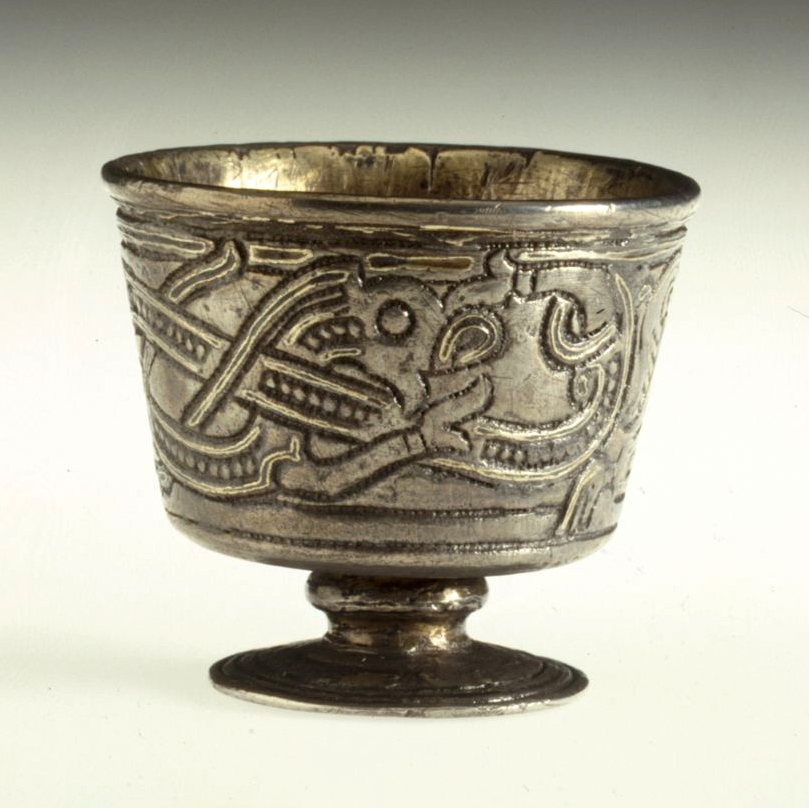
Jelling Cup - Gelmir
For tattoo purposes, wyrms are ideal. The coiling, elongated form wraps beautifully around limbs. The heads can anchor a composition at the wrist or the shoulder. I have wreathed countless wyrms around arms and legs over the years, and they never get old.
6. YGGDRASIL
Yggdrasil is the centre of the universe in Norse mythology. It is the world tree, and it carries the nine worlds in its branches. Beneath its roots lie three wells, or springs, the sources of life and wisdom. It is so vast that the eye cannot see it, and the mind can hardly fathom it.
Upon the crown of the tree sits a vast eagle, who harbours a deep hatred of the serpent Nidhog (Níðhöggr), who gnaws at the roots underground. Between the two runs Ratatoskr, the messenger squirrel, carrying words of spite and anger from one to the other. Yggdrasil is commonly referred to as an Ash, but some theorise that the tree is in fact a Yew, as Yews are often seen as undying.
Yggdrasil is the centre of all, upon which all orbits and at the end-times of Ragnarok, the tree will burn and topple.
Having a love of trees, it is no surprise that I have a stylised version of Yggdrasil on me, though it covers around a third of my body, which may lend it more persuasive weight.
HISTORICAL SOURCES
Precise Viking Age depictions of Yggdrasil are rare, which is part of what makes finding them so satisfying. The Överhogdal tapestry from Sweden contains a beautiful geometric tree that most scholars interpret as Yggdrasil. I have made a modern rendition of it. However, we will release this as a free design in our newsletter very soon. The Mammen axe bears an extraordinary knotwork tree on its blade, which is difficult to read as anything other than a cosmic or sacred tree. And the Vang stone from Norway has a piece of Ringerike knotwork that reads clearly as some form of significant foliage. Possibly Yggdrasil, possibly not, but certainly inspired by the same symbolic tradition.
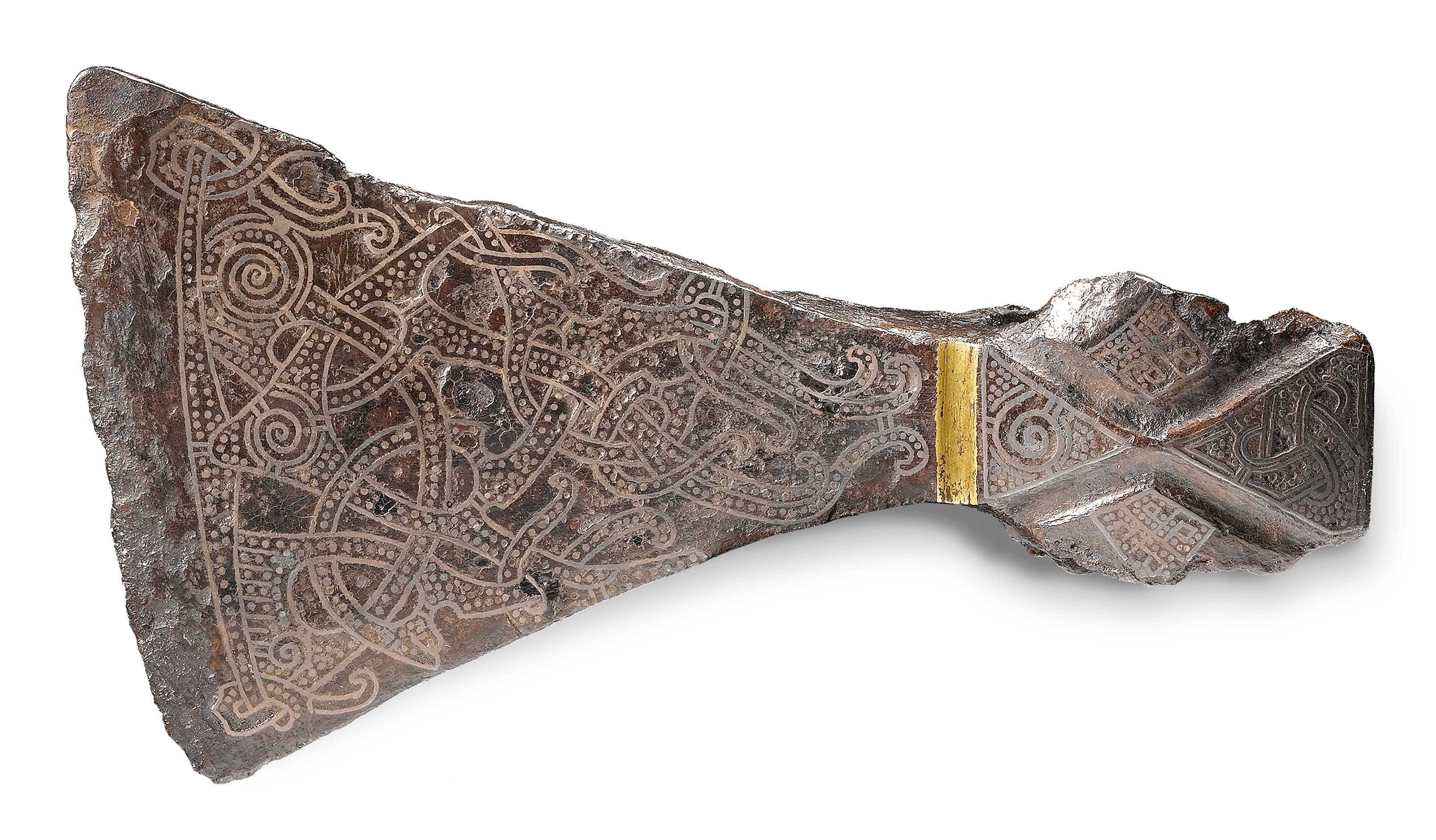
Mammen Silver-Inlaid Axehead
As a tattoo, Yggdrasil offers an enormous scope. It can be intimate and minimal, or it can become a full back or body piece. The symbol earns whatever scale you give it.
7. THE VALKNUT
Yes, this one appears in the other list too. That is intentional.
The Valknut is a three-triangle knot found in Viking Age and pre-Viking contexts. Its connection to Odin and to death is strong, appearing on the Lärbro Tängelgårda stones from Gotland in close proximity to what appear to be sacrifice scenes, and on Oseberg grave goods in multiple forms. It is not a symbol that was casually deployed.
WHY IS IT ON BOTH LISTS
It is on the "not to get" list because it has been misappropriated by far-right groups in the modern era, and because people frequently get it without understanding what it actually represents. It is on this list because that is not the symbol's fault. The Valknut predates those groups by more than a thousand years and carries genuine historical weight. Knowing that context, and being prepared to explain it, puts you in a very different position to someone who picked it from a flash sheet because it looked cool.
If the Valknut's associations with Odin, with the cycle of death and transformation, with the binding and unbinding of fate, resonate with you, and you approach it with that understanding and idea, there is no reason not to get it. The best protection against misuse of any symbol is knowledge of what it actually means.
WHAT IT MEANS
We do not have a written account of the Valknut from the Viking Age. What we have is a consistent archaeological context: Odin, death, ritual, transformation. Some scholars, including Hilda Ellis Davidson, interpret it as connected to Odin's power to bind the minds of warriors and shamans. That reading carries weight. It is not a symbol of hatred. It is a symbol of the most serious aspects of Norse cosmology: the passage between worlds, the cost of wisdom, and the weight of fate.
8. RUNES
Yes, there were only meant to be seven. Consider this an honorary addition.
Runes are historical, versatile, and adaptable, making for brilliant tattoos. Each of the 24 Elder Futhark runes carries its own meaning, sound, and cosmological weight. They can be worn individually, combined into bindrunes, or used as structural elements within larger compositions. The design possibilities are genuinely vast.
That vastness is exactly why this entry is short. Runes deserve their own post, and they will get one. Watch this space.
While you wait, check out all of our runebooks!
FAQS ABOUT VIKING TATTOO DESIGNS
ARE THESE DESIGNS SUITABLE FOR ANY TATTOO STYLE?
Yes, with the right artist. Many of these designs originated in styles like Ringerike, Mammen, Jelling, and Urnes, which have their own visual logic built around flowing lines, interlocking animal forms, and negative space. A skilled tattoo artist who understands these styles will serve you far better than one who tries to impose a different aesthetic onto historically specific material. If you want to go deeper into the styles themselves, the Viking Art books cover each one in detail, with design examples, and the Nordic tattoo books can help you find the right artist for your tattoo!
DO I NEED TO BE PAGAN OR NORSE TO GET THESE TATTOOS?
No. These are historical designs from an extinct culture and line of traditions. You do not need a religious or ethnic connection to appreciate and wear them respectfully. What matters is that you understand what you are getting and why.
WHERE DO I FIND REFERENCE MATERIAL FOR THESE DESIGNS?
The artefacts named throughout this post are a starting point. Many are available through museum collections, books on Viking Age art, and academic resources. The Northern Black Viking Art books contain designs drawn directly from historical artefacts, organised by chapter and annotated, so you can explore each category in depth.
HOW DO I KNOW IF A DESIGN IS HISTORICALLY ACCURATE?
If the reference can be traced to a named artefact, a specific location, and an approximate date, it is historically grounded. If it cannot, it may still be a good design, but it is a modern creation. Neither is inherently wrong. The important thing is that you know what you are getting. There are hundreds of designs on the internet inspired by different Nordic styles, worthy of at least inspirational attention.
Is AI a good source for Viking tattoos?
No, AI is far from capable of creating suitable designs of any kind of tattooing, as AI has not understood what can and cannot be tattooed, it fails at understanding body dynamics, and it is it capable of creating knotwork that is woven correctly. And considering how many other options you have available, from the art books we sell to visiting museums and working with historical tattoo artists, even commissioning designs from skilled artists, avoiding the failures within AI is easy.
THE DEEPER POINT
Viking Age art is one of the richest visual traditions in human history. It is built from wolves and serpents, from gods and giants, from the tension between chaos and order that runs through all of Norse cosmology. The designs on this list have survived more than a thousand years because they are extraordinary. They will outlast a trend.
If you want a tattoo that carries real weight, go to the source. Learn the artefacts. Find an artist who understands the tradition. The history is there for anyone willing to look for it.
If you want to explore the historical designs behind these symbols, our Viking Art books contain hundreds of designs drawn directly from named Norse artefacts. Browse the collection here.
Author: Isar Oakmund, tattoo artist, Norse Historical art scholar and Founder of Northern Black.
Northern Black publishes historically grounded art books, rune guides, and Norse-inspired designs rooted in the real archaeological record. Explore the Viking Art collection and Nordic Tattoo books.


Comments
I learn more daily about my Swedish heritage, it has always been such a question mark for me as my Grandmother Soderlund said that we were descendants of a Viking Prince.
The truth of that is unknown as she was a tavern singer and drank a lot….
You are so right! At least someone that is clever. Everything you whright here are so interesting. Thanks. Best regards Ebba