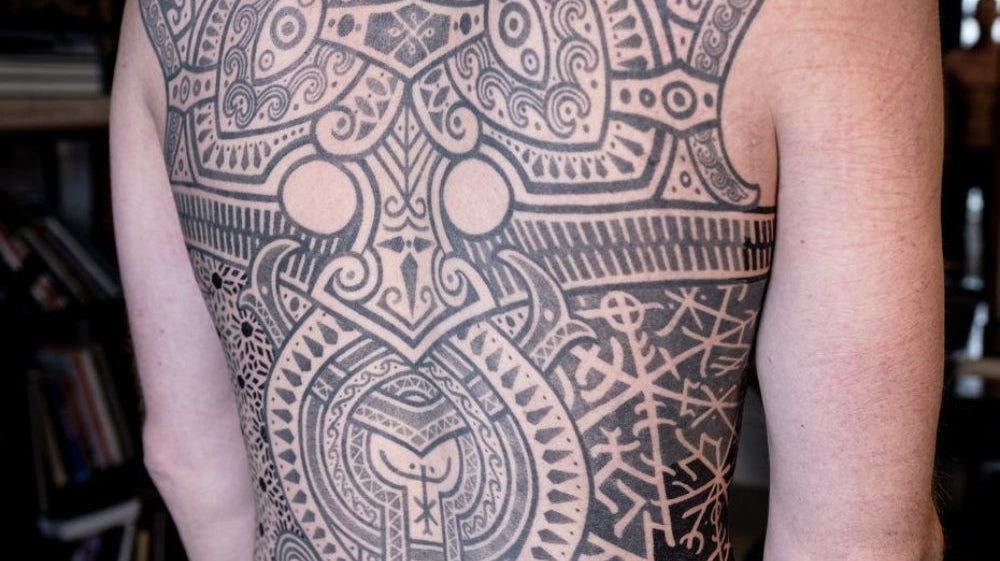
Norse godmasks are carved faces from the late Iron Age and Viking Age that show up on runestones — often by rivers and fords — and across objects like ship gear, shrine boxes, weapons, and amulets. They likely served apotropaic (evil-averting) and presence-invoking roles. The same face motif inspires modern art and tattoos — from Odin’s one-eyed wisdom to Loki’s stitched-lip trickery.
ARE NORSE GODS REAL?
Yes, because they are concepts. On a level of practical magic, they are real, but on a more constructional level, it’s a personal thing. I don’t run around in a forest yelling for Odin, but if anyone feels like doing that and, importantly, believes in it, then I assume to them Odin is very real.
Personally, I see them as constructs and concepts that were historically needed in human society. Interestingly, the Nordic Pantheon doesn’t require you to believe only in Nordic gods. For example, Vikings believed in both the existence of Norse gods and Christ, as they seemed to have seen them as competing forces.
WHAT ARE NORSE GODMASKS?
A Norse godmask is a carved or engraved face — human, divine, or somewhere between — that stands in for sacred presence. These masks appear on runestones (some with just the face; others with memorial text), amulets, horns, jewellery boxes, oars, and metalwork dating from the Migration Period through the Viking Age (c. 800–1050 CE).
Their exact purpose remains a mystery. Some scholars suggest they were protective symbols — a watchful divine face warding off evil at sea or in battle. Others believe they were ritual representations used in ceremonies or initiations, similar to sacred masks in other world traditions.
But perhaps the most compelling theory is that godmasks were both art and invocation — faces carved to give form to unseen forces, and intended to scare the crap out of you.
THE ORIGINS OF GODMASKS: WHY CARVE A FACE?

The roots of the godmask concept likely predate Norse religion itself. Early Germanic and Scandinavian art featured stylised human or semi-human faces long before the Viking Age.
Archaeologists have found Bronze Age sun chariots and Iron Age helmets (such as the Viksø Helmets from Denmark, c. 900 BCE) adorned with facial imagery. These early masks may have symbolised divine presence — the idea that by donning or displaying a “face of power,” a human could channel something greater.
By the Viking Age, this concept had evolved. Instead of wearable masks, many depictions became engraved symbols carved into ships, stones, or weapons — enduring markers of divine favour and protection.
WHO WERE DEPICTED IN GODMASKS?
We believe that godmasks are representations of divine beings. And with that being said, we already encounter our first problem. The concept of divine beings in Nordic mythology is a very broad term. The world teemed with spirits, ancestors, land-wights, Jötnar, and powerful female entities, including the Dísir, Valkyries, and Norns. A carved face could be:
-
A guardian at a boundary or crossing
-
A marker of presence in memorial settings
-
An invocation — the face as a portal through which the unseen looks back.
Because of this diversity, a “godmask” could represent almost any being within this spiritual spectrum — a god, a spirit, a giant, or an ancestral force. The stones and carvings found often do not explicitly name their subjects, leaving room for interpretation and mythic imagination.
THE SYMBOLISM BEHIND THE GODMASK
The meaning of a godmask depends on who, or what, it represents.
1. MASKS AS THE FACE OF POWER
A godmask may not depict a specific deity but rather the idea of divine presence itself — a way of embodying sacred power in a visible form.
2. THE PROTECTIVE FACE
Some archaeologists have argued that the carved faces on ships or weapons did more than fill empty space. They may have been meant as simple protective markers—nothing grand, just a way to give misfortune a hard stare. It’s the same idea you see in gargoyles or the Celtic Green Man: a face set in place to keep watch, whether the threat was physical, spiritual, or simply the long odds of travel in the early medieval world.
3. THE SHIFTING IDENTITY OF THE DIVINE
In Norse myth, even gods wear disguises. Odin is notorious for walking the mortal realm in many forms. Loki changes shape constantly. Masks, therefore, might also represent transformation, trickery, and the fluid boundary between divine and mortal identity.
ARE THERE VIKING GODMASKS?
Yes. Archaeological evidence shows carved godmasks on stones and boats from what we now call the Viking Age. But “Viking” is a cultural shorthand. The godmasks we have evidence for come from across the broader Scandinavian world; they’re not limited to the groups who travelled, traded, or raided abroad.
FAMOUS EXAMPLES OF NORSE GODMASKS
While few artefacts survive intact, several notable discoveries give us glimpses into this ancient art form:
THE SNAPTUN STONE (DENMARK)

The Snaptun Stone, dated to around the year 1000 CE, is believed to depict the Norse god Loki. The figure carved on the stone has stitched lips, a probable reference to the myth in which Loki’s mouth was sewn shut after he angered the gods with his lies.
This puts the Snaptun Stone among the rare pieces that may show Loki himself. So it’s little wonder people still turn to it when they’re looking for a starting point for Loki-inspired tattoos or artwork.
Indeed, you could possess your very own Loki godmask:
THE SJELLEBRO STONE (DENMARK)

A mask stone with no runic inscription still stands where it was first set, beside a river crossing in Denmark. It’s just the face itself, nothing more. With no text to explain its purpose, many readers of the site assume it was meant to look out for travellers and turn aside whatever was thought to linger around the crossing.
DR 66 “MASK STONE”, ÅRHUS (DENMARK)

This godmask stone was laid down in 1289 as a foundation stone in Erik Menved's Mill. It was discovered when one of the millhouses burned to the ground in 1849. The mask is often regarded as protective as well as commemorative.
The inscription on the stone reads:
"Gunnulfr and Eygautr/Auðgautr and Áslakr and Hrólfr raised this stone in memory of Fúl, their partner, who died when kings fought."
BEYOND STONE: GODMASKS ON SHIPS, SHRINES, WEAPONS & AMULETS
Across the Viking world, the same carved features appear on ships, weapons, reliquaries, jewellery, and personal charms — everywhere life met risk or reverence. The consistency of the godmask motif suggests it wasn’t bound to one cult or region, but part of a shared Scandinavian visual language: a face to confront the unseen. Seen on ships, axes, and shrine lids, these masks point to a habit of adding religious or protective elements to practical objects.
Here are some examples:
A GODMASK ON AN OAR FORK AT GOKSTADSSKPET, NORWAY

There’s also a carved face on a Gokstad oar-fork, which makes sense for people whose travel and trade depended on the sea.
The Bamberg Shrine

The Bamberg casket, an 11th-century shrine in the Mammen style, has at least seven godmasks carved into its clasps and decorative panels.
GUDRUN'S CANE/CRUTCH HANDLE

Gudrun’s cane handle is made from red deer antler, with a godmask on one side and an animal figure on the other. Again decorated in Mammen style, which dates the piece to somewhere between 900 and 1030.
SWORD HILT OF ELK HORN FROM SIGTUNA, SWEDEN

This Sigtuna elk-horn sword hilt carried a godmask into battle and travel.
SILVER AMULET FOUND IN GNEZDOVO, NEAR SMOLENSK, RUSSIA

Godmask pendants, amulets, and metal fittings have been found in Norway, England, Denmark, and Russia.
“TURNING MASKS” (HIDDEN FACES)

Some pendants are reversible; turn them upside down and a second face appears in the carving. The presence of multiple suspension loops suggests they were meant to be worn either way. It fits well with the broader Norse interest in disguise and shifting identity.
ARE GODMASKS EXCLUSIVELY NORSE?
Far from it. The use of masks to represent divine beings is found across many ancient cultures — from the Greek masks of Dionysus to African and Oceanic ritual masks. Across the world, divine masks are technologies of transformation — you don’t just imitate the god; you host it. Norse sources emphasise shape-shifting (Odin, Loki) and seiðr (altered states), so even if wearable masks rarely survive, carved faces likely functioned as ritual mediators: fixed guardians in public places; portable presences on gear and amulets.
WHAT ABOUT ODIN, THOR, AND OTHER NORSE GODMASKS?
We don’t have confirmed historical godmasks for the named deities — no stone says “this is Odin.” But that absence is liberating. It means that each new creation can draw directly from the ideas these gods represent, rather than copying a fixed image.
When I design a godmask, I try to capture an essence — the attitude, the role, the feeling of the god behind the myth. Modern godmasks, whether drawn, tattooed, or sculpted, can channel that same energy.
Odin Godmask – One eye, a knowing expression, or a hooded gaze can embody the pursuit of wisdom and the sacrifice it demands. A modern Odin godmask might merge contemporary geometry with runic forms to suggest insight through endurance.
Thor Godmask – Broad features, heavy brows, or knotwork echoing Mjölnir capture strength and protection. Many tattoo artists adapt this into symmetrical designs that feel both defensive and grounding..
Njord Godmask – Calm eyes, flowing lines, and wave-like engravings can evoke the sea’s generosity and unpredictability. Njord represents wealth, wind, and water — the quiet strength that sustains life and trade. You can see that balance between beauty and force in our Silver Njord God Mask Necklace, designed to honour the oceanic calm beneath the storm.
Freyja Godmask – Feminine masks with feline eyes or wing-like markings can represent love, fate, and battlefield grace. These designs honour the duality of beauty and ferocity found in Freyja’s myth. Our Freya godmask t-shirt perfectly portrays her fierce femininity.
Creating new godmasks isn’t about imitation. It’s about participation — continuing a conversation with the divine in forms the old world never had the chance to finish. Every mask is an invocation, a mirror, and a question: What face do you choose to show?
HOW TO GET A GODMASK TATTOO

If you’re thinking about wearing one of these faces on your skin, start with The Viking Art Tome. It’s my most complete work to date — over 300 pages of Norse-inspired design, archaeology, and symbolism. Inside, I’ve gathered the godmasks and other motifs that shaped the old world, alongside notes on how they can live again through art and tattoo.
You’ll find detailed mask designs drawn from real artefacts and stone carvings, with notes on context and meaning, so your tattoo isn’t just decoration, but something that carries the weight of the story behind it.
And a small but important note: the designs are for personal use only, including tattoos — not for commercial reproduction.
If you’d like to explore it, the book’s available here:
While you’re pondering your tattoo, why not treat yourself to a God of Ink T-shirt, designed in the more ancient styles that predated the Viking age, to honour the connection and heritage of artwork established long before Europe entered the so-called Viking age.
EXPLORE OUR BOOKS, CLOTHING, AND JEWELLERY INSPIRED BY NORSE TRADITION — FROM CARVED MASKS TO SILVER PENDANTS — MADE TO KEEP THE GODS CLOSE, WITHOUT TURNING THEM INTO SOUVENIRS.
First published: 22 February 2023
Updated: 5 December 2025