
On certain winter nights, according to Northern European folklore, the sky is not empty.
The wind is not merely weather. The storm is not simply a storm. And the sound of hooves, horns, and baying hounds overhead is not something to be investigated lightly.
This is the Wild Hunt — a spectral procession of riders, the dead, gods, and monsters sweeping across the winter sky. It is one of the oldest and most widespread myths in Northern Europe, appearing in Norse mythology, Celtic tradition, Germanic folklore, and later Christianised accounts. While modern retellings often flatten it into a spooky trope or fantasy set piece, the original Wild Hunt was something far more serious: a warning, a seasonal truth, and a reminder that winter belongs as much to the dead as to the living.
WHAT IS THE WILD HUNT MYTH?
At its core, the Wild Hunt myth describes a supernatural host travelling through the night sky, usually during winter storms. Witnesses might hear the sounds of horns, chains, hooves, howling dogs, or the roar of unseen riders overhead. To see the Hunt was often considered an omen of death, war, famine, or catastrophe — sometimes personal, sometimes communal.
What matters most is that the Wild Hunt is not preserved as a single story. It is preserved as a pattern — one that appears across Northern and Western Europe with remarkable consistency:
-
a leader who stands between worlds
-
a host made up of the dead or the not-quite-living
-
violent weather and liminal winter nights
-
consequences for those who interfere or look too closely
Our first solid accounts of the Wild Hunt don’t come from Viking storytellers at all, but from slightly alarmed medieval monks. In 1091, Orderic Vitalis described a nocturnal procession of armed dead. Not long after, the Peterborough Chronicle reported black riders and hounds with eyes like saucers thundering through the winter sky for the better part of nine weeks. No one called it the Wild Hunt yet, but the key elements were already present: riders, unrest, and the uncomfortable feeling that the dead were taking the long way round.
THE WILD HUNT IN NORSE MYTHOLOGY

Norse sources never use the term “Wild Hunt,” nor do they present a single episode in which Odin formally leads one. This has led some modern readers to assume the idea was imported later. In reality, Norse mythology contains everything the Wild Hunt requires, simply expressed differently.
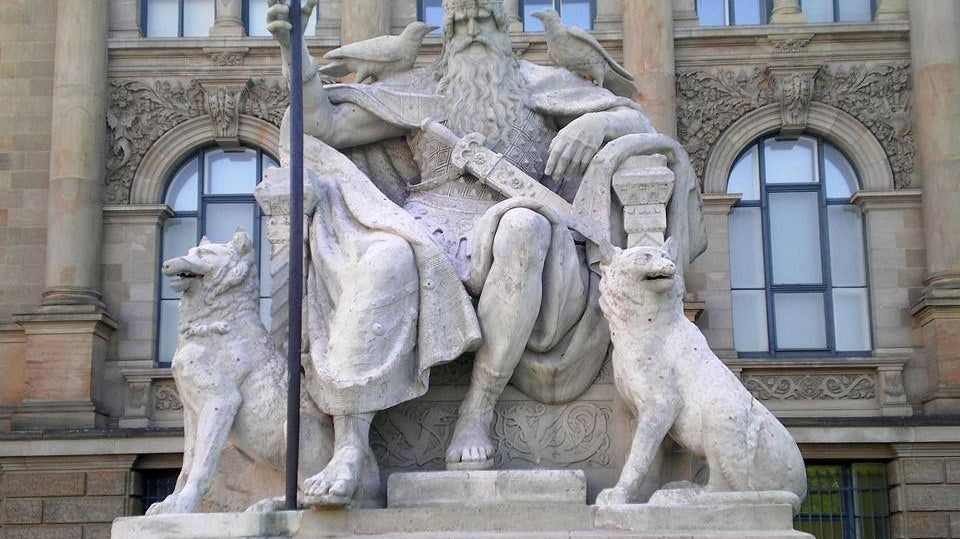
The Wild Hunt in Norse mythology is most strongly associated with Odin, the Allfather — a god whose portfolio already includes death, war, frenzy, poetry and magic. If any deity was going to lead a ghostly army across the winter sky, it was always going to be him.
Odin is not a benevolent grandfather figure. He is a god of bargains, sacrifices, and hard knowledge. He rides the eight-legged horse Sleipnir, travels between worlds, and gathers the slain into Valhalla. His association with the Wild Hunt is a natural extension of his role as a psychopomp — a guide of souls.
In this context, the Wild Hunt of Odin is not a random haunting. It is Odin riding with the einherjar — the chosen dead warriors of Valhalla — and possibly other restless spirits, ancestors, or beings not bound to one realm.
In the Poetic Edda, Odin names himself Valföðr — “Father of the Slain”:
“Valföðr I am called, for the slain I choose.”
FOR READERS WHO APPRECIATE MYTHOLOGY AND INNUENDO IN EQUAL MEASURE, OUR ODIN “HUNG LIKE A GOD” T-SHIRT IS THE PERFECT YULETIDE GIFT
OSKOREIA: THE NORWEGIAN WILD RIDE
In Norway, the Wild Hunt survives in later folklore as Oskoreia (sometimes Åsgårdsreia). No one entirely agrees on the name’s first element, though it has long been linked to Óðinn or to Ásgarðr, which certainly fits the company he keeps. The stories themselves were written down centuries after the Viking Age, yet the shape of them — the midwinter ride, the dead on the move — feels far older than the manuscripts that preserved them.
People in Norway said Oskoreia rode out on the darkest winter nights, most of all around Yule. The riders might be the dead or the generally unfortunate, along with a handful of beings no one wanted to meet after dusk, and the whole troop was usually placed under Odin’s command — or someone very like him. Anyone who stumbled into their path was thought to be in real trouble: swept away, frightened out of their wits, or dragged into the procession itself.
Importantly, Oskoreia reinforced winter behaviour:
-
Stay indoors during storms
-
Respect hospitality customs
-
Do not wander alone in the dark.
Folklore often doubles as survival advice. In this case, ignoring Oskoreia meant ignoring winter itself — something the North has never tolerated.
THE WEATHER WON’T ALWAYS TELL YOU WHAT YOU NEED TO KNOW. THE RUNES MIGHT
DID THE VIKINGS CELEBRATE THE WILD HUNT?
The Vikings did not celebrate the Wild Hunt, nor did they mark it on a calendar with a feast, a blót, or a named festival. There is no evidence of a formal ritual dedicated to a sky-riding host of ghosts and gods.
But the absence of ceremony does not mean the absence of belief.
In the Viking Age and throughout pre-industrial Europe, winter was genuinely life-threatening. No insulation, no central heating, no artificial light, no reliable supply chains. A poor harvest meant hunger; hunger meant disease; disease meant death. Entire families and communities could — and did — fail to survive harsh winters.
The later folklore of Oskoreia clearly preserves this mindset: fear, avoidance, and respect. These are the responses of people who believe something dangerous is afoot — not of people telling a story for amusement.

Among the most striking pieces of evidence for how early Norse culture imagined the movement between worlds is the Tjängvide image stone, carved on Gotland sometime between the 8th and 9th centuries. Like many Gotland stones, it compresses myth, memory, and cosmology into a single panel of densely symbolic imagery.
At the centre is a mounted figure on an unmistakably eight-legged horse — almost universally read as Odin on Sleipnir. The horse’s unnatural stride, stretched across the stone, suggests not mere riding but passage: a journey across realms, or toward the dead.
In front of the rider, a woman holds out a drinking horn. Anyone who knows their sagas will recognise the pose: it’s how the dead are greeted when they arrive in the next world. Whether she’s a valkyrie, a disir, or simply a tidy way of saying “this way, please,” the meaning is clear enough.
Below that scene, a ship ferries more figures along the same route, hinting that the journey beyond wasn’t imagined as a solitary stroll, but a passage many travellers made together. The composition as a whole does not depict a “Wild Hunt” in the later folkloric sense, but it captures the older foundation beneath it: a god on the move, accompanied by the dead, travelling through the liminal space between life and whatever lies beyond.
The Tjängvide stone does not explain itself — none of the stones do. But it shows, clearly and without literary embellishment, that the Norse understood the dead as moving together, and Odin as their natural leader. It is one of the earliest visual echoes of the same instinct that later crystallised into the Wild Hunt myth.
FOR THOSE WHO PREFER THEIR MYTHIC STEEDS IN A COLOUR UNAVAILABLE IN THE VIKING AGE, CHECK OUT OUR SLEIPNIR PINK PONY CLUB T-SHIRT
THE EINHERJAR AND THE ARMY OF THE DEAD
The presence of the einherjar within the Wild Hunt is not explicitly laid out in a single neat saga passage (Norse mythology is rarely so cooperative), but the connection is logical and widely supported by later folklore.
The einherjar are Odin’s warriors — the slain chosen from battlefields to fight again at Ragnarök. They train, feast, and wait. Winter, a season already associated with death and dormancy, is a fitting time for them to ride.
The Wild Hunt, in this sense, may reflect an ancestral belief that the dead are not gone — merely elsewhere.
THE WILD HUNT GHOST RIDERS ACROSS NORTHERN AND WESTERN EUROPE
The Wild Hunt is not exclusively Norse. Variations of the same storm-riding host appear across Northern and Western Europe, each with its own local names, leaders, and emphases, but all recognisably part of the same pattern.

GERMANY: WOTAN’S HEER OR WILDE JAGD
In German-speaking lands, the Hunt goes by names such as Wilde Jagd (“Wild Hunt”), Wütendes Heer (“Raging Host”), or Wildes Heer (“Wild Army”). Its leader is often Wodan (Odin), but in later tales the role is handed to figures like Knecht Ruprecht, Holda, Perchta, or a cursed nobleman doomed to ride forever. Sometimes the host pursues a specific quarry — a hart, a woman, or a demon — and sometimes it simply thunders past, leaving fear and broken branches behind. Dogs and wolves are common, as are horses with unnatural numbers of legs or fiery eyes. The emphasis here is on the Hunt as a raging army, an omen of war and unrest.
ENGLAND: HERNE THE HUNTER, LATER FOLKLORIC FIGURES
In England, the motif fragments into a cluster of names and tales, including Woden’s Hunt, Herla’s Company, Gabriel’s Hounds, the Devil’s Dandy Dogs, and more. Chroniclers like those behind the Peterborough Chronicle describe black riders and black hounds seen and heard over the countryside for weeks on end, taken as a sign that something had gone badly wrong in the moral or political order.

Later, the leader becomes Herne the Hunter, a horned figure haunting Windsor Forest, or a restless king, or a local noble who broke sacred laws. Different names, same structure: a leader on horseback, a ghostly pack, and a warning on the wind.
CŴN ANNWN: THE WELSH HUNT
In Welsh tradition, the Hunt belongs to the Otherworld, particularly the fae folk. Here we meet Gwyn ap Nudd, a ruler of Annwn, riding at the head of white hounds with red ears — the Cŵn Annwn.
In the First Branch of the Mabinogi, the Cŵn Annwn are described as:
“White, with red ears; and as they moved, the nearer they were, the quieter they seemed, and the farther away, the louder.”
They’re not Christian hellhounds, despite what later storytellers tried to make of them.

These dogs belong to the Otherworld, chasing souls or marking the moment when someone crosses from one realm into another. The sound of their approach is unnerving: they grow quieter as they draw near and louder as they recede, a neat way of signalling that normal rules do not apply.
The emphasis in Welsh tradition is less on a raging army and more on the boundary between this world and the next.
The presence of the Hunt in Celtic lands strengthens the argument that this myth is ancient, predating Christianity and surviving it through adaptation rather than replacement.
SCOTLAND: SPECTRAL RIDERS AND DEATH-PROCESSIONS
In Scotland, the Hunt appears in stories of spectral riders and death-processions crossing the sky or moving along old roads and over hills. The Scottish material shifts around more than the Welsh or German tales, but the mood is familiar enough: shadowy riders, a wailing wind, and tales of tragedies in their wake. Sometimes the riders are tied to the Seelie or Unseelie Court; sometimes they’re the unquiet dead or a cursed band of nobles. It gives Scotland’s Hunt the air of a travelling court from the other side, passing sentence as it goes.
FRANCE: MESNIE HELLEQUIN
France preserves the Wild Hunt under names like Mesnie Hellequin (“Hellequin’s household”) and la chasse fantastique. Medieval writers describe a spectral company, sometimes led by a figure named Hellequin — a name likely related to earlier English traditions about King Herla. Elsewhere in French folklore, we find ghostly huntsmen such as Le Grand Veneur in the forest of Fontainebleau, or cursed hunters forced to ride at night for breaking sacred prohibitions (hunting on a Sunday being a favourite sin). Again, the details change, but the core remains: a nocturnal troop, a leader bound to the dead, and a sense that this is the price for transgressing old laws.
Taken together, these are not “borrowed” stories in the modern sense, as though one nation invented the Wild Hunt and everyone else plagiarised it. What we’re seeing in all these versions is the same old instinct expressed in different places: when winter settles in, the dead are on the move. They travel together, and they follow a figure who stands somewhere beyond the living world — whether that’s a god, a king, or someone who answers to older rules than we do.
That’s the backbone of the story. The rest is local flavour.
CHRISTIANISATION AND SANITISATION
When Christianity spread through the North, it didn’t wipe the Wild Hunt away. It just gave it new characters. The Devil or a demon took on Odin’s role, or a cursed lord, and the host became a swarm of lost souls. The message to stay indoors on stormy nights survived; the theology behind it was all that changed.
Later folklorists, including Jacob Grimm, recognised these stories as survivals rather than inventions — though modern scholarship rightly treats Grimm’s conclusions with caution.
Later still, the Hunt became entertainment — a motif for stories, games, and fantasy novels. Something was lost in that transition: the sense that the myth once mattered.
The Wild Hunt was not a children's fairy tale. It was a reminder that once upon a time, winter was harsh and you were never guaranteed to see it through to the following year.
IF YOU PREFER WINTER FOLKLORE WITHOUT THE THREAT OF ABDUCTION, OLD MOTHER FROST MAKES A FAR MORE AGREEABLE BEDTIME COMPANION.
A BEARDY CHAP FLYING ACROSS THE SKY WITH A MAGICAL PONY? SOUNDS FAMILIAR
At a glance, the Wild Hunt and Santa Claus appear to belong to entirely different worlds. One is a terrifying winter procession of the dead, the other a domesticated figure of comfort, gifts, and reward. And yet, it would be hard to read all of this and not notice some similarities.
This is not because Santa is a disguised pagan god, nor because Odin “became” Santa. Those claims flatten centuries of cultural change into a slogan. What we are looking at instead is mythic inheritance — older winter beliefs reshaped to suit new religious and social needs.
In the old Norse stories, Odin turns up most often as a wanderer in the winter months. He rides the sky, slips between worlds, and shows himself on the strange nights when the year is shifting. He can be generous to those who show him respect and sharply unforgiving to those who don’t.
As Christianity took hold across Northern Europe, the dangerous authority of Odin was gradually softened and redirected. Saint Nicholas absorbed the role of winter gift-giver and moral judge. Figures like Father Christmas in England, Knecht Ruprecht in Germany, and the Dutch Sinterklaas carried older traces of winter lore with them — furred clothing, nighttime visits, long journeys — though their roles changed a good deal under Christian influence. In some regions of Germany and the Pennsylvania Dutch communities, characters such as Belsnickel (a fur-clad, switch-carrying enforcer of good behaviour) or Schmutzli in Switzerland preserved the wilder, rougher aspects of earlier winter spirits. As time went on, the fear faded. Warnings turned into promises, and the stern winter visitor eventually morphed into a jolly, rotund gift-bearer.

That business of riding through the sky says a lot. The idea of a supernatural being crossing the winter darkness is older than Christianity and the Coca-Cola idea of Santa by a long stretch. In the Wild Hunt, it’s a terrifying rush of noise and force, a harbinger of doom. Today, that same journey has become a prophecy of glee, the storms have become sleigh bells, and what once frightened people is now a warm, exciting celebration.
The Wild Hunt represents winter as it was once experienced: harsh, unpredictable, and inhabited by forces beyond human control. As Europe industrialised, food was easier to come by, electricity and heating became the norm and winter became survivable; the story had to change. Where the old Hunt warned communities about survival, the new visitors warned children about their good or bad behaviour. The danger moved from the world outside to the world inside the nursery.
Seen this way, Santa is not the Wild Hunt in disguise — he is what remains now that the winter has been tamed.
THE ECHO OF HOOVES IN WINTER
The Wild Hunt is not a single story, nor a relic from the sagas, nor a curiosity tucked safely into folklore collections. At its heart, it was a warning for people to stay safe during the cold months.
Centuries later, the world changed. Winter tempered, houses warmed, and the terror that once crept along the edges of the year faded into memory.
But something of the old instinct remains. Even today, when the wind rises suddenly or a storm rattles the windows, there is a flicker — a sense that the season holds deeper currents than we admit, and it is easy to understand why our ancestors believed the dead were riding.
And perhaps, in a mythic sense, they still are.
IF ODIN’S HOST IS OUT TONIGHT, THERE’S NO SENSE GOING ANYWHERE — EXCEPT ONLINE. BROWSE THE NORTHERN BLACK SHOP AND ARM YOURSELF APPROPRIATELY FOR THE DARK MONTHS AHEAD.