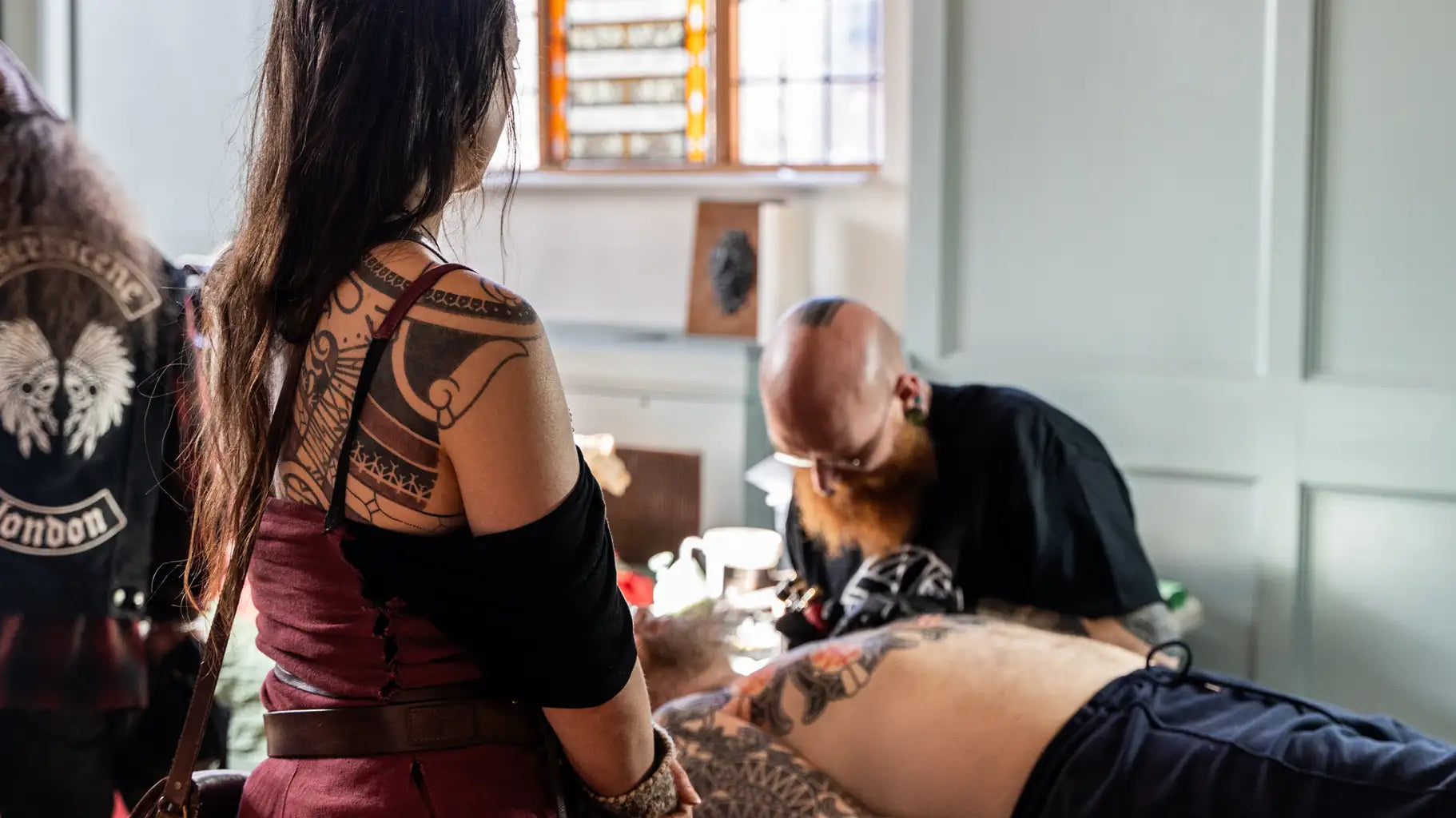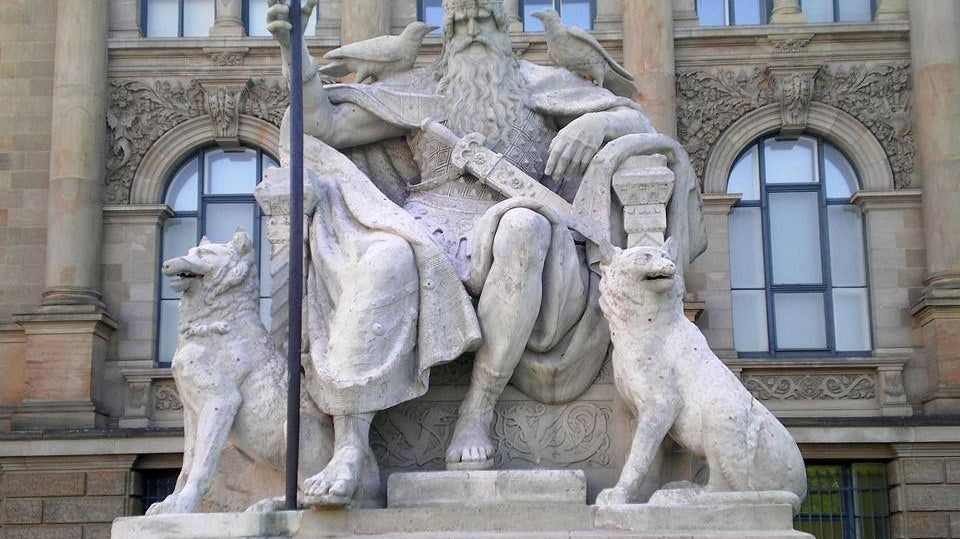

If you believe everything the internet tells you, every Viking was tattooed from scalp to toes, each line loaded with ancient magic, forgotten gods, and at least one symbol that “definitely means protection.”
The reality is more awkward. And more interesting.
No preserved Viking Age Scandinavian body with tattoos has been found. No skin. No ink. No archaeological mic-drop moment where we all nod and move on.
So why does the idea of tattooed Vikings refuse to die? Because there is one compelling historical description — and a great deal of cultural context — sitting in the grey space between possible and provable.
This article looks at what we actually know, what we think we know, and why certainty remains out of reach.
VIKING TATTOOS: THE EVIDENCE PROBLEM
Tattoos live on skin. Skin seldom survives.
Viking Age burial practices don’t help. Cremation was common in many regions and periods. Skin does not survive cremation. Inhumation (burial) preserves bones, not soft tissue. Even exceptionally well-preserved Viking graves almost always yield skeletons, rather than intact bodies.
So when people say “no Viking tattoos have been found,” what they really mean is: No tattooed Viking skin has survived to be found.
That’s not the same as proof they didn’t exist, but it's why the argument hasn’t been settled. Of course, this also means that while a well-preserved Viking hasn’t been found yet, it could conceivably happen. So if a Viking was killed and fell into a peat bog, or was buried under ice, there’s a chance we could find out in the future.
RELATED: VIKING BURIALS AND THE AFTERLIFE IN NORSE MYTHOLOGY
THE ONE WRITTEN SOURCE EVERYONE ARGUES ABOUT
If you’ve ever heard someone declare, with great certainty, that “Vikings definitely had tattoos,” the claim almost certainly traces back to one man: Ahmad Ibn Faḍlān.
In 921–922 CE, Ibn Faḍlān travelled along the Volga River and encountered a group he calls the Rūs — river traders operating far from Scandinavia, but widely understood by historians to include men of Scandinavian origin.
Ibn Faḍlān’s account survives in later manuscript copies, meaning we are reading a text transmitted through centuries of copying and preservation. It is not a stenographic transcript. In that text, he writes that the Rūs were:
“from the tips of his toes to his neck, marked with dark green designs.”
That sentence is doing a lot of work in modern imagination.
WHAT DID IBN FAḌLĀN ACTUALLY SAY?
The Arabic verb often translated as “tattooed” is not a neat, modern technical term. It can carry meanings closer to marked, stained, decorated or inscribed.
Scholars differ on how literally to read it. Some translators render the passage explicitly as “tattooed.” Others choose the more cautious phrasing of “marked” or “decorated.”
There is also debate around the colour description. Popular retellings frequently claim Ibn Faḍlān described “green trees.” However, philological notes in more careful translations suggest the wording may simply indicate dark green pigment, not literal tree imagery. With that said, I can imagine runes looking like trees to someone who has never seen them before.
In other words, we have a description of full-body markings and a reference to dark green colouring, but no technical explanation of the method or whether the markings were permanent or temporary.
TATTOO, PAINT, OR STAIN?
Scholars typically consider three possibilities:
PERMANENT TATTOOS (PIGMENT INSERTED UNDER THE SKIN)
This is the reading most people prefer — partly because it aligns neatly with modern expectations.
Tattooing was technologically simple and widely known across Eurasia long before the 10th century. There is nothing impossible about the Rūs having been tattooed. But the text does not explicitly describe puncturing, pricking, or embedding pigment under skin, because, of course, Ibn Faḍlān was not present when they were created.
SURFACE BODY PAINT OR STAINING
Another possibility is that Ibn Faḍlān observed pigment applied to the skin’s surface.
This interpretation gains weight from:
-
the absence of technical detail,
-
the potential ambiguity of the verb,
-
and the fact that ritual or decorative body paint existed in various cultures.
However, paint would typically wear off. Ibn Faḍlān’s description does not imply temporary decoration, but he also does not comment on permanence.
SCARIFICATION OR COMBINED TECHNIQUES
Some researchers have suggested that the markings were created by cutting or scarification combined with pigment — a method known across multiple cultures.
Again, the text itself does not specify.
HOW RELIABLE IS THE ACCOUNT?
This is where serious historians slow down.
Ibn Faḍlān was an outsider, writing about unfamiliar customs, describing people he clearly found physically impressive but culturally alien.
He does not appear confused or fantastical in this passage. His descriptions of clothing, weapons, hygiene practices, and funerary rites are detailed and observational.
That strengthens the case that he really did see something distinctive, but we must also remember that he was not writing an ethnographic manual, nor documenting tattoo technique, and he probably wasn’t trying to settle a future internet argument.
He recorded what stood out to him.
THE COLOUR QUESTION
The phrase describing the colour is often translated as something like “dark green” or “greenish.” That raises practical questions:
-
What pigment would produce that shade?
-
Would healed charcoal tattoos appear dark green under certain lighting?
-
Could copper-based pigments have been used?
-
Could “green” reflect the way aged ink appears on pale skin?
Without preserved examples, we cannot test this.
But scholars generally agree that medieval Arabic colour terminology does not map perfectly onto modern English colour categories. “Green” may not mean the bright emerald often imagined in modern illustrations.
FOR COLLECTORS, TATTOO ARTISTS, AND ANYONE WHO PREFERS THEIR TATTOO INSPIRATION PROPERLY SOURCED, DISCOVER THE NORDIC TATTOO TRIO:
WHO WERE THE RŪS?
The Rūs described by Ibn Faḍlān were not a tidy ethnic category. They were a trading group operating across eastern river networks — likely including Scandinavians, but also possibly Slavs, Finns, and others.
This matters because, even if the markings are tattoos and some of the men were Scandinavian, it does not automatically follow that all Vikings everywhere did the same thing. At best, the account shows that some Scandinavian-connected people may have marked their bodies in some way.
ARCHAEOLOGY: WHY IT DOESN’T SETTLE THE QUESTION
‘TATTOO TOOLS’ AREN’T STRAIGHTFORWARD
Sharp objects survive well in the archaeological record. Context does not.
A pointed iron or bone tool could be a sewing awl, leatherworking equipment, a woodworking marker, a medical tool, or maybe a tattooing implement.
There are Viking Age artefacts that have been suggested as tattoo tools, including a comb-like iron object from Vendel, but none are universally accepted as such. The same object can plausibly belong to several crafts.
PIGMENTS DON’T HELP MUCH EITHER
Charcoal, iron oxides, and dark pigments appear everywhere in hearths, smithies, paint, cosmetics, woodworking, and writing. Finding pigment is not the same thing as finding tattoo ink.
WHAT DOES VIKING ART SHOW US?
If tattoos were widespread, prestigious, or culturally central in Viking Age Scandinavia, we might reasonably expect to see them reflected somewhere in surviving art.
So what does the material actually show? The honest answer is: nothing we can confidently identify as tattooing.
FIGURINES: DETAILED… BUT NOT THAT DETAILED

The Hårby Valkyrie, a 10th-century silver figurine from Denmark, is one of the most refined human representations we have from the Viking Age.
The figure wears layered, patterned clothing, carefully rendered hair, jewellery, and weaponry, but shows no obvious signs of skin markings.
Now, that alone proves nothing. These figurines are tiny. Fine surface detail — especially something as subtle as healed ink under skin — would be difficult to render in cast silver at that scale.
But it does tell us something important: tattooing was not emphasised in this artistic medium.
THE GOTLAND PICTURE STONES: NARRATIVE, NOT ANATOMICAL

The carved stones of Gotland are filled with imagery of warriors, ships, mounted figures, and mythological scenes, often interpreted as arrivals in Valhalla.
They are rich in story, but not in anatomical realism.
Human figures tend to be stylised silhouettes. Clothing, weapons, and posture are conveyed. Musculature is rarely detailed. Skin surface decoration is not depicted. If tattoos existed, this artistic tradition was not concerned with showing them.
THE OSEBERG TAPESTRY FRAGMENTS

The textile fragments from the Oseberg burial include processional scenes with human figures. We see garments, headgear, and objects carried in ritual contexts.
We do not see visible tattoos. Again, this is woven textile — not a portrait study. Fine surface skin detail would be extremely difficult to represent. The absence is therefore unsurprising. But it remains an absence.
In the end, the art tells the same story as the archaeology: Viking tattoos remain in the realm of possibility, not proof.
CONTEXT MATTERS: TATTOOING EXISTED IN THE VIKING WORLD’S ORBIT
Tattooing was not unknown in Europe and Eurasia during the Viking Age. In several regions, we have preserved skin, identifiable tools, and written descriptions confirming that permanent body marking was practised.
That does not prove Vikings tattooed themselves — but it does dismantle the argument that tattooing would have been unthinkable, exotic, or culturally alien.
To understand that, it helps to look beyond Scandinavia.
ÖTZI THE ICEMAN: EUROPE’S OLDEST TATTOOED BODY

Ötzi lived around 3300 BCE — over two millennia before the Viking Age. His body, preserved in Alpine ice, contains 61 tattoos.
They are not elaborate knotwork or mythic beasts. They are simple lines and crosses.

What makes Ötzi particularly relevant is the location of the tattoos. According to research published by the South Tyrol Museum of Archaeology, the markings appear on parts of the body that show signs of strain and degeneration, including the lower back, knees, and ankles. They were also placed along points that correspond strikingly with acupuncture lines still recognised today.
Scientists now widely believe these tattoos were therapeutic rather than decorative — likely created by cutting the skin and rubbing charcoal into the wound in an attempt to alleviate pain.
This matters for two reasons:
-
Tattooing in prehistoric Europe was already established.
-
It was not necessarily aesthetic or status-driven. It could be medical, ritual, or functional.
Tattooing, in other words, was a technology — not just an art form.
THE PAZYRYK MUMMIES: COMPLEX TATTOO ICONOGRAPHY

Frozen burials in the Altai Mountains (c. 500 BCE) preserve some of the most elaborate ancient tattoos ever discovered.
These include:
-
Mythical beasts
-
Interwoven animals
-
Stylised predator forms.
The artistic sophistication rivals the metalwork and textile designs of the same culture.
Why is this relevant? Because it shows that by the Iron Age, complex symbolic tattooing already existed across Eurasia. Animal-style art — not entirely unlike motifs seen in Norse material culture centuries later — could be rendered on skin.
Again, preserved skin resolves the question instantly.
ROMAN ACCOUNTS OF NORTHERN ‘PAINTED’ PEOPLES: THE PICTS
Roman writers described northern Britons as “painted” — the Latin picti meaning “painted ones.” Whether this refers to tattoos or body paint remains debated.
But what it shows clearly is that body-marking traditions existed in regions that the Vikings would later raid, trade with, and settle in.
Tattooing was part of the wider cultural landscape of northern Europe.
WHAT THIS CONTEXT ACTUALLY TELLS US
Across Europe and Eurasia we have:
-
Confirmed prehistoric tattooing (Ötzi)
-
Elaborate Iron Age tattoo art (Pazyryk)
-
Classical descriptions of marked northern peoples (Picts)
-
Identifiable tattoo tools in cultures such as Ancient Egypt.
Tattooing was technologically simple. It required only a sharp tool and pigment. It existed in neighbouring and interacting cultures. Crucially, Vikings also demonstrably altered and marked the body in other ways, including deliberate tooth filing.
That makes tattooing plausible within the Viking world — but still unproven. The body was not off-limits as a canvas of identity. The evidence simply hasn’t survived to tell us whether ink was part of that story.
WHAT VIKINGS DEFINITELY DID: BODY MODIFICATION AND SYMBOLIC MARKING
FILED TEETH: AN UNDERRATED PIECE OF EVIDENCE

It’s worth noting that recent archaeological research has confirmed that permanent body modification did take place in Viking Age Scandinavia — just not in the form of preserved tattoos. A 2023 study by Matthias S. Toplak and Lukas Kerk identified over 130 male skeletons with deliberately filed teeth, with a striking concentration on Gotland, and three confirmed cases of artificial skull modification, all female and also from Gotland.
The authors argue that tooth filing was likely a deliberate social marker — possibly linked to male merchant groups — while skull modification appears to have been a foreign custom introduced via eastern connections and later reinterpreted locally.
That alone tells us something important: Vikings were willing to alter the body permanently, for reasons tied to identity, status, or belonging. It doesn’t prove tattooing, but it makes the idea far less implausible.
RUNES, SYMBOLS, AND PATTERN — JUST NOT ON SKIN
Runes are extremely well attested:
-
Carved into stone,
-
Scratched onto bone,
-
Cut into wood,
-
Stamped into metal.
What we don’t have is a single confirmed example of runes applied to skin in the Viking Age.
That’s why claims about long rune phrases, bind runes, or complex sigils as “traditional Viking tattoos” should be treated carefully. Many such designs come from later medieval sources, early modern manuscripts, or entirely modern esoteric traditions. None of that makes modern Norse-inspired tattooing invalid. It simply makes it modern.
24 RUNES. 100+ BIND RUNES. ONE WORKING GUIDE. DISCOVER RUNES, SIGILS & BIND RUNES.
IF VIKINGS HAD TATTOOS, WHAT MIGHT THEY LOOK LIKE?
If we assume that some Scandinavians did tattoo themselves, the most responsible place to look for design clues isn’t modern fantasy art. It’s the actual visual language of the Viking Age.
We have several well-documented art styles from the period, preserved in metalwork, stone carving, wood, and textiles. If tattoos existed, they would almost certainly reflect those forms.
SALIN’S STYLE 1 (C. 400-600 AD)

Fragmented animal forms. Bodies are broken into abstract pieces — hips, shoulders, jaws and eyes floating within geometric frames. It looks disassembled and compact.
SALIN’S STYLE II (C. 500-650 AD)

Elongated, ribbon-like animals interlaced into tight patterns. Heads in profile, gripping paws, looping bodies. More fluid than Style I, but still tense and compact.
SALIN’S STYLE III (C. 650-800 AD)

Transitional and more regional. Animals become less fragmented and more coherent, with clearer bodies and decorative detailing.
BROA STYLE (C. 750-830 AD)

Named after finds from Gotland. A bridge between Migration Period animal art and Viking Age styles. Complex, curling animals with open compositions and early tendrils.
OSEBERG STYLE (C. 800-880 AD)

Flowing, gripping animals with elegant curves and surface ornament. Rich carving detail. More decorative and less aggressive in feel.
BORRE STYLE (C. 850–950 AD)

Dense interlace. Ring-chain patterns. Symmetrical gripping beasts with strong outlines. Compact and repetitive.
JELLING STYLE (C. 900–975 AD)

S-shaped animals with ribbon bodies and simple internal detailing. More open compositions compared to Borre style and less crowded.
MAMMEN STYLE (C. 950–1025 AD)

More naturalistic animals combined with plant tendrils. Greater detail and ornamentation. Transitional toward Christian-era aesthetics.
RINGERIKE STYLE (C. 1000–1075 AD)

Tall, slender animals with spiral hips and pronounced tendrils. Increased elegance and vertical movement with more refined symmetry.
URNES STYLE (C. 1050–1125 AD)

Highly refined and minimalist. Extremely slender animals, almond-shaped eyes, tight loops, and controlled negative space. The most elegant of the Viking styles.
AND THE RUNES?
Runes were carved, not illustrated. They are alphabets with structure and meaning. If they were ever applied to skin, the most likely forms would be short inscriptions or names — not dense, decorative bind rune collages.
History leaves marks. Artists reinterpret them. The Nordic Tattoo Trio gathers ancient visual languages and places them in the hands of today’s strongest Nordic tattoo artists.
FOR TONS MORE INFO ON VIKING ART STYLES AND OVER 300 PAGES OF NORSE VISUAL HISTORY. DISCOVER THE VIKING ART TOME.
A WORD ON MODERN ‘VIKING TATTOOS’
Modern Norse-inspired tattoos are part of a living culture now. They’re art and identity. For some, they’re spiritual. For others, they’re simply beautiful. They don’t require archaeological approval to exist, and they certainly don’t need a museum label to justify themselves.
But if historical accuracy matters to you — and for some people it genuinely does — then it’s worth slowing down a little. Lean into the art styles we can actually point to, like Borre, Jellinge, Mammen, Ringerike, and Urnes. These are real. They’re attested in metalwork, stone carving, wood, and textiles. They give you more than enough material to work with without inventing anything.
The same goes for runes. They’re not mysterious squiggles for filling space. They’re alphabets. They had structure, grammar, and context. Using them well — sparingly, correctly, with an understanding of what they actually say — carries far more weight than stitching together a bind rune found on a Pinterest board labelled “ancient protection sigil.”
And when it comes to symbols confidently marketed as “Viking,” a little caution goes a long way. Some have medieval roots. Some are early modern. Some are entirely modern. That doesn’t make them meaningless — it just makes them younger than the marketing suggests.
There’s nothing weak about saying your tattoo is inspired by the Norse world rather than directly copied from it. In fact, it shows respect. Honesty is far more compelling than borrowed certainty.
RELATED: 5 VIKING TATTOOS YOU SHOULD NOT GET (AND WHY)
SO DID VIKINGS HAVE TATTOOS? THE HONEST CONCLUSION
We may one day find preserved Viking Age skin with tattoos. Peat bogs and permafrost have surprised archaeologists before.
Until then, the most accurate position is this: Tattooed Vikings are possible, plausible, and unproven. And frankly, that uncertainty is far more interesting than a fake certainty ever was.
EXPLORE OUR BOOKS, APPAREL, HOMEWARE AND RUNES ROOTED IN NORSE TRADITION — DESIGNED WITH RESPECT FOR THE PAST.