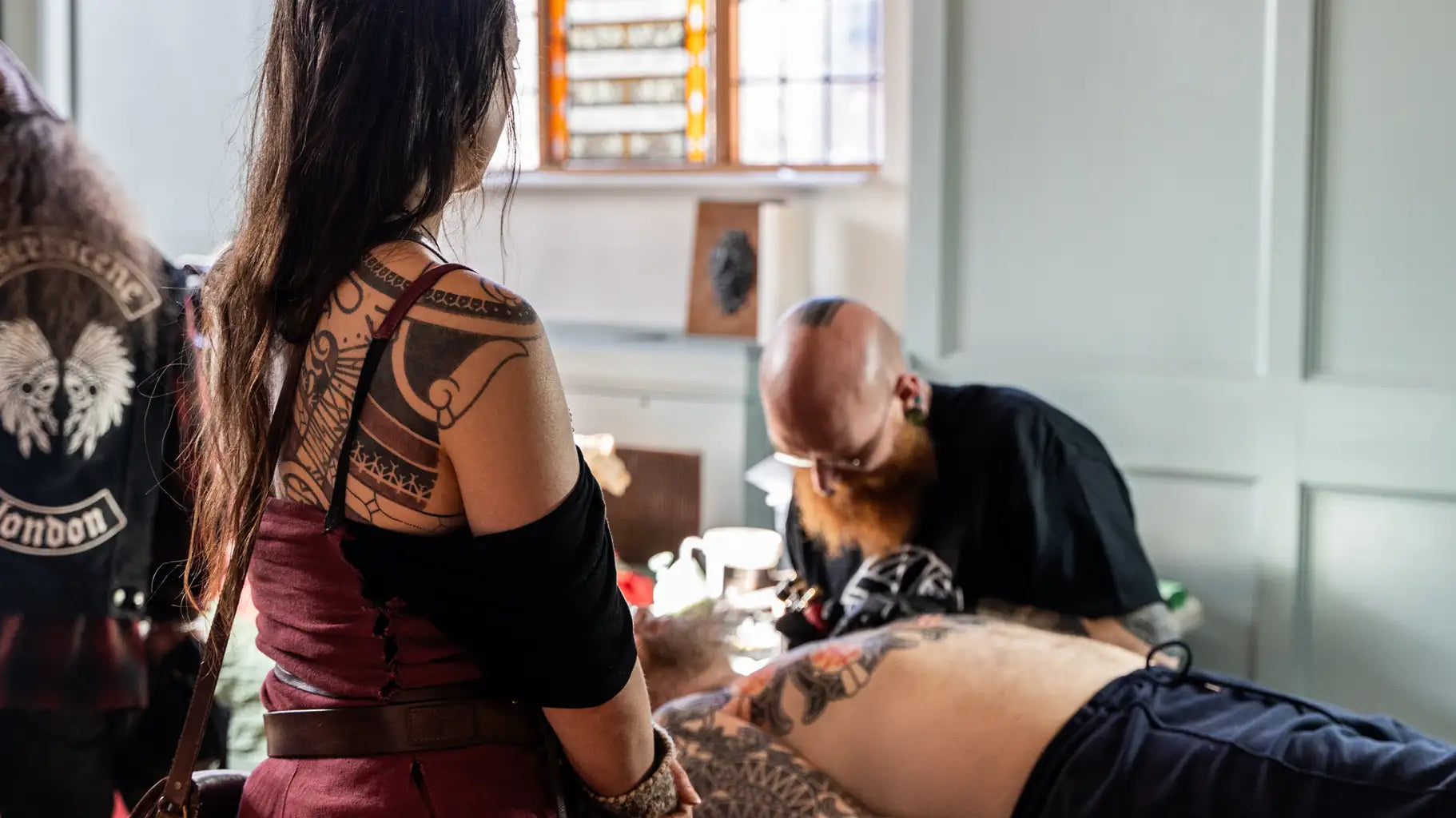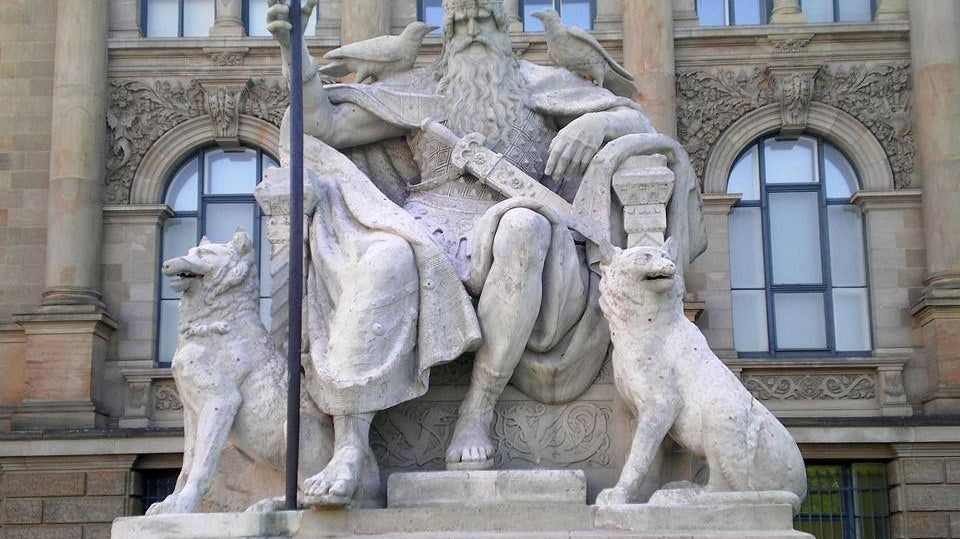

The Norse gods have an annoying habit of refusing to stay politely in the past. They appear in sagas, on stones, in half-remembered folktales… and increasingly on people’s biceps. Whether you’re here because you genuinely want to understand the Æsir and Vanir, or because you want a tattoo that won’t make a historian hiss through their teeth, consider this your field guide to the Norse pantheon — the real one, not the Marvel one.
ÆSIR AND VANIR: TWO FAMILIES, ONE CHAOTIC PANTHEON
The Norse pantheon is essentially two clans:
-
The Æsir — the gods of power, law, war, and sky. They’re the ones most people know: Odin, Thor, Loki (though he is… complicated), Frigg, Tyr, Heimdallr, and so on.
-
The Vanir — the older agricultural gods, associated with fertility, prosperity, magic, and the slightly more grounded parts of life. Freyja, Freyr, and Njörðr are their heavy hitters.
The two groups famously went to war, realised it was pointless, exchanged hostages, and then politely pretended nothing had happened — which, to be fair, is very Scandinavian. The story of their strife and peacemaking is an odd tale, and worth a future blog post for sure, so stay subscribed for that one to come.
THE ÆSIR: GODS OF MIGHT, OATHS, BATTLE, AND UNEXPECTED FAMILY DRAMA

ODIN — THE ALLFATHER, RAVEN-KEEPER, AND PERPETUAL KNOWLEDGE ADDICT
If there’s one god whose name people tattoo before doing any research, it’s Odin. The Allfather is the one-eyed wanderer, god of kings, poets, warriors, death, prophecy, and any field where a poor decision made with confidence can change the world.
He sacrificed an eye for a single drink from Mímir’s well, and later hung himself on Yggdrasil for nine nights to receive (or steal) the runes — a level of academic commitment not seen since the invention of student loans.
His two ravens, Huginn (Thought) and Muninn (Memory), act as his eyes and ears across the worlds. Odin is closely linked to Sleipnir, the eight-legged horse (yes, the one Loki gave birth to; no, we’re not getting into that here). Norse mythology is rich, but it is not tidy.
One of the many reasons much is know and more is speculated about Odin, is his many guises and many names, he is mentioned by more than 100 names in sagas, poems and myths.
Odin is a favourite among tattoo enthusiasts because his iconography — one eye, ravens, spear, runes — is visually powerful and historically rooted.
Symbols: runes, ravens, wolves, Gungnir, Valknut, the gallows/tree, godmasks.
Rune: Ansuz (ᚨ) — breath, inspiration, divine communication.
ONE EYE. ENDLESS CONFIDENCE. ODIN ENERGY, NOW IN SHIRT FORM
[product-handle]hung-like-a-god-t-shirt[/product-handle]
THOR — THE THUNDERER, GIANT-CRUSHER, AND UNINTENTIONAL FOLK HERO
Thor is the working-class hero of Norse myth. While Odin whispers riddles, Thor solves problems by hitting them with Mjölnir, the most reliable tool in the cosmos. He defends both gods and humans from giants, trolls, and anything else that looks at him incorrectly.
His strength is immense, but so is his appetite, humour, and occasionally his gullibility. Thor’s chariot is pulled by two goats — Tanngnjóstr and Tanngrisnir — which he can slaughter and resurrect as a snack between battles. He’s also the only god to go undercover in full bridal attire (to retrieve his stolen hammer), making him inadvertently one of the most gender-fluid icons in the sagas, except for Loki, of course.
Thor’s hammer is also the single most tattooed symbol in Norse heritage. If you plan to get one, avoid designs that look suspiciously like 20th-century reinterpretations. Go for archaeological finds and knotwork designs with historical ties.
Symbols: Mjölnir, thunder and lightning, goats, oak trees.
Rune (speculative but traditional in modern practice: Thurisaz (ᚦ) — force, conflict, raw power.
WHY CHOOSE ONE MJÖLNIR WHEN YOU CAN WEAR THE WHOLE MUSEUM?
[product-handle]ancient-hammer-heads-t-shirt[/product-handle]
FRIGG — QUEEN OF THE ÆSIR, WEAVER OF FATE, AND PATRON OF THE HOUSEHOLD

Frigg is often overshadowed by Odin, which is ironic given that she habitually knows more than he does. She commands a quieter, deeper power than the battle-focused gods around her. She possesses frith, the sacred peace that binds families and kingdoms, and she is mistress of spinning, weaving, childbirth, and foresight. According to Gylfaginning, she sees all destinies — but rarely shares what she knows.
She also presides over marriage and oaths, which makes her one of the foundational deities of social order. Her hall, Fensalir, is described as a place of calm waters and sanctuary — a rare oasis in the drama-drenched world of the Æsir.
Her maternal grief over the death of Baldr remains one of the most poignant stories in Norse myth, illustrating her role as the emotional core of Asgard.
Symbols: spindle, keys, mist, motherhood.
Rune: Berkano (ᛒ) — growth, protection, the feminine mysteries.
Fun fact: Frigg is associated with Friday (Frigg’s day), which should make her the patron saint of early weekends.
LOKI — TRICKSTER, SHAPE-SHIFTER, AND AGENT OF NECESSARY CHAOS
Loki is not technically Æsir, nor Vanir, nor a villain, nor a hero. He is the son of Fárbauti and Laufey (both jötnar) and is responsible for roughly 80% of events in the sagas. Some good, some catastrophic, some involving eight-legged horses.
He helps the gods as often as he harms them, though not always intentionally. He fathers monsters, steals Sif’s hair, causes Baldr’s death, invents nets, shapeshifts into a mare to distract a giant’s stallion, and gives birth to Sleipnir. Loki is the mythic embodiment of “I can fix this,” immediately followed by “I have made it worse.”
He is charisma wrapped around volatility — a favourite figure for people who embrace transformation, rebellion, or complicated personal narratives.
Symbols: fire, nets, serpents, masks.
Runic associations: none historically attested — modern practitioners sometimes connect him to Kenaz (fire/transformation), but this is symbolic rather than archaeological.
ADD A LITTLE MISCHIEF TO YOUR SACRED SPACE
[product-handle]altarpiece-loki-godmask[/product-handle]
Loki is the father (and sometimes mother) of many beings who appear in Norse myth — but we’ll save the beasts, monsters, and horses for another time.
TYR — GOD OF OATHS, HONOUR, AND THAT ONE VERY BAD DAY WITH FENRIR

Tyr doesn’t get nearly enough love. worshipped in older Germanic tradition long before Odin took centre stage, Tyr may have been the chief sky god — his name is etymologically linked to deus, “god.” He governs honour, law, and the binding force of sworn oaths. But his defining act is the binding of Fenrir, the giant wolf prophesied to kill Odin.
Knowing the wolf would not allow himself to be bound unless one of the gods offered a hand as proof of honesty, Tyr stepped forward. He lost a hand. He did not complain.
This act defines Tyr’s nature: courage without theatrics, integrity without self-praise. For anyone who values quiet strength, Tyr is the god who sees you.
Symbols: the one-handed warrior, the wolf-binding, the sky.
Rune: Tiwaz (ᛏ) — justice, honour, duty.
A PARTING GIFT FOR FENRIR: THE HAND, AND THE FINGER THAT WENT WITH IT
[product-handle]limited-edition-hand-of-tyr[/product-handle]
Tyr is the perfect tattoo subject for anyone who values integrity over comfort — or knows what it’s like to get bitten by life and keep going anyway.
HEIMDALLR — GUARDIAN OF BIFRÖST AND PATRON OF CHEWING QUIETLY

Heimdallr is the ever-watchful sentinel of the gods. With hearing so sharp he can detect wool growing on sheep, he is the ultimate boundary-keeper. His horn, Gjallarhorn, will one day announce Ragnarök.
His origin is strange even by Norse standards: in Rígsþula, he may be the forefather of humankind, travelling the world under the name Rígr and founding the social classes. He is bright, noble, vigilant — a god of structure, order, and alertness.
He is also, perhaps, Loki’s eternal rival. There is something mythically satisfying about Chaos and Vigilance glaring at each other across a bridge.
Symbols: Gjallarhorn, the rainbow bridge, bright armour.
Rune: Algiz (ᛉ) — protection, guardianship.
BALDR — THE BELOVED, THE BRIGHT ONE, AND THE CATALYST OF RAGNARÖK
Baldr is the god everyone loved, which in Norse mythology should immediately raise suspicion. Beautiful, wise, gentle, and shining with an almost supernatural radiance, Baldr embodied purity and the promise of peace.
He was so beloved that Frigg took oaths from every living thing not to harm him. Every living thing except the mistletoe, a plant considered “too young to swear.” Loki, never one to ignore a loophole, fashioned a dart from mistletoe and guided the blind god Höðr’s hand.
Baldr’s death shattered the Æsir and set the long spiral toward Ragnarök.
His dwelling, Breiðablik, is described as a place where nothing impure can exist — a poetic echo of his nature. After Ragnarök, Baldr is foretold to return from Hel’s realm to help rebuild the world, making him one of the few shining notes of hope in an otherwise doom-heavy cosmology.
Baldr represents innocence, renewal, forgiveness, and the fragile beauty that even gods could not protect forever.
Symbols: sunlight, purity, mistletoe.
Rune: Wunjo (ᚹ) — joy, harmony, blessedness.
HÖÐR — THE BLIND GOD WHOSE AIM WAS TRAGICALLY GOOD
Höðr (Hodr) is the blind god tricked by Loki into killing his brother Baldr with a dart of mistletoe. A symbol of misplaced trust and the merciless momentum of fate. Redeemed after Ragnarök when he returns alongside Baldr.
BRAGI — GOD OF POETRY, MEMORY, AND THE TONGUE THAT CAN SAVE OR DOOM YOU
Bragi’s gift is words — the good kind, not the corporate email kind. Married to Idunn, he carries poetry, storytelling, lore, and the sacred memory of culture. Viking skalds invoked him before reciting praise poems, hoping not to embarrass themselves in front of a king.
Bragi doesn’t appear as often in surviving myths, but where he does, he elevates everything around him.
IDUNN — KEEPER OF THE APPLES OF YOUTH AND THE REASON THE GODS LOOK SURPRISINGLY FRESH
Idunn is the guardian of the apples that keep the gods young. When Loki once allowed her to be kidnapped, every deity in Asgard visibly aged — a rare mythological admission that even gods have limits.
She represents renewal, spring, health, and vitality. She may not swing a hammer or hurl lightning, but without her, the pantheon would look like a retirement home within a fortnight.
SIF — GODDESS OF WHEAT, EARTH, MARRIAGE, AND “THINGS LOKI SHOULDN’T HAVE CUT”
Sif’s golden hair is a symbol of ripe grain fields — an agricultural metaphor made literal in myth. When Loki shears her hair as a prank, Thor is furious enough to force him to commission new hair crafted by dwarves from actual gold.
Sif is grace, nourishment, stability, and the quiet abundance that feeds nations.
NANNA — DEVOTED WIFE OF BALDR AND SYMBOL OF GRIEF WITH GRACE
Dies of heartbreak when Baldr is killed and joins him in Helheim. A gentle deity associated with love, loyalty, and peaceful afterlife reunions.
FORSETI — GOD OF JUSTICE, MEDIATION, AND SETTLING ARGUMENTS WITHOUT AXES
Forseti, son of Baldr and Nanna, presides over Glitnir, a radiant hall where disputes are settled fairly. He is everything Tyr would be if Tyr had a conflict-resolution certificate.

VÍÐARR — THE SILENT AVENGER WHOSE SHOES SAVE THE WORLD
Víðarr barely speaks, but when he does, it’s usually fatal for giants. He avenges Odin at Ragnarök by tearing Fenrir’s jaw apart using a magically reinforced shoe. Introverts everywhere claim him.
VÁLI — THE ONE-DAY-OLD AVENGER
Born explicitly to avenge Baldr’s death, grows to adulthood in a day, completes his mission, and quietly returns to the background. The Norse equivalent of a mythological hitman.
SAGA — GODDESS OF STORIES, LORE, AND SHARED DRINKS BY SACRED SPRINGS
Possibly an aspect or companion of Frigg, Saga oversees storytelling and sacred wisdom. Her hall, Sökkvabekkr, is ideal for literary retreats with divine company.
FULLA — FRIGG’S HANDMAIDEN AND HOLDER OF MANY SECRETS
Carries Frigg’s casket, wears a golden headband, and guards her secrets with the seriousness of a royal archivist.
SJOFN — QUIET GODDESS OF LOVE AND AFFECTION
Turns hearts toward love, nudging humans toward affection with more subtlety than Freya’s methods. Patron of quiet romance.
SNOTRA — GODDESS OF WISDOM, ETIQUETTE, AND BEING UNBOTHERED
Symbolises intelligence, courtesy, and composed behaviour. A deity for those who appreciate tact over drama.
LOFN — PATRON OF FORBIDDEN LOVE AND UNIONS AGAINST THE ODDS
Helps bring about marriages that are frowned upon or blocked. Essentially, the divine advocate for “yes, you can love each other.”
GEFJON — LAND-MAKER, OXEN-WRANGLER, AND GODDESS OF SOVEREIGNTY
Ploughs part of Sweden into Denmark using her giant sons transformed into oxen. Patron of sovereignty, agriculture, and boundary-setting — literally.
EIR — HEALER OF THE GODS
Associated with medicine and miraculous cures. Appears in lists of goddesses and Valkyries, reinforcing that healing and battle were never separate fields in Norse life.
HERMÓÐR — THE MESSENGER OF THE GODS AND THE ONLY ONE BRAVE ENOUGH TO RIDE TO HEL
Hermóðr the Brave is the messenger of the gods, sometimes described as a son of Odin. When Baldr dies, Hermóðr volunteers to ride nine nights through darkness to Helheim to plead for his return. He leaps over Hel’s gate on Sleipnir, bargains with Hel herself, and almost succeeds — until Loki ruins everything (as usual).
He is associated with courage, diplomacy, and long journeys that no one else wants to make.
THE VANIR: THE OLDER, WILDER, EARTH-ROOTED POWERS
FREYJA — GODDESS OF SEIÐR, LOVE, MAGIC, AND THE SENSIBLE DISTRIBUTION OF FALLEN WARRIORS

Freyja is, frankly, magnificent. She is the mistress of seiðr magic, chooser of half the slain, patron of lovers, wealth, independence, and beauty that does not apologise.
She receives first choice of slain warriors in Fólkvangr, even before Odin takes the rest to Valhöll — a fact modern practitioners often find very telling.
She is the patron of seiðr, the shamanic magic involving trance, prophecy, and reweaving fate. She commands passion, sovereignty, independence, and fierce loyalty. Her necklace, Brísingamen, is one of the most iconic items in Norse lore.
Freyja is associated with transformation (her falcon cloak), enormous chariot-pulling skogkatts, love, desire, and immeasurable magical skill. For those who walk between worlds — or simply refuse to be underestimated — she is the goddess who answers.
Symbols: cats, falcon cloak, Brísingamen, tears of gold.
Rune: Fehu (ᚠ) — wealth, energy, primal power.
EMPOWERMENT LOOKS GOOD ON YOU. FREYA INSISTED.
[product-handle]freya-godmask-high-neck-crop[/product-handle]
READ MORE>> FREYA: LADY OF LOVE, WAR, AND A PAIR OF CATS
FREYR — PEACE-BRINGER, PROSPERITY GOD, AND DEFINITELY NOT SUBTLE
Freyr is everything that grows, thrives, and multiplies. Worship of Freyr is archaeologically widespread, especially in Sweden, where statues of the god (enthusiastic sculptural anatomy included) have been found.
He wields a sun-bright sword, later given away for love — a symbol of sacrifice and kingship. His sacred boar, Gullinbursti, shines with golden bristles and represents protection and abundance.
Freyr governs good harvests, peace treaties, marriages, and prosperity. He is the god invoked when life needs to flourish rather than merely survive.
Symbols: boar, sun, phallic idols, ship.
Rune: Ingwaz (ᛜ) — growth, fertility, stored potential.
NJÖRÐR — GOD OF SEA, WEALTH, WIND, AND EVERY FISHERMAN’S LAST HOPE
Njörðr is beloved by sailors, merchants, fishermen, and anyone who has ever tried to predict the weather and failed. As a Vanir hostage living among the Æsir, he represents the uneasy but productive peace between the two clans.
He controls seas and winds, brings wealth from overseas, and protects those who travel or trade. His marriage to the mountain-loving Skaði is famously miserable, illustrating one of the earliest examples of “long-distance relationship problems.”
Njörðr remains one of the most practical deities — the one you call on when you need fish, waves to surf, or a merchant ship that does not sink.
Symbols: ships, fishing nets, seabirds, wind.
Rune: Laguz (ᛚ) — water, flow, intuition.
CALL THE SEA-GOD WHO BRINGS WEALTH, WIND, AND GOOD TIDES
[product-handle]silver-godmask-necklace[/product-handle]
NERTHUS — EARTH MOTHER, PEACE-BRINGER, AND THE GODDESS WHO REQUIRED EVERYONE TO BEHAVE THEMSELVES
Nerthus is one of the oldest Germanic goddesses on record, mentioned by Tacitus long before the Viking Age. She’s a primordial Earth Mother associated with fertility, peace, and sacred processions. When Nerthus was paraded in her veiled wagon, all weapons were laid down and conflicts ceased — temporarily enforcing peace by the overwhelming power of divine disapproval.
A quiet but potent figure who reminds us that long before the Æsir and Vanir were arguing, the Earth itself was already sacred.
IF YOU’D LIKE THE GODS TO HANG ON YOUR WALL, CHECK OUT OUR ART PRINTS TO FIND ODIN, FRIGG, FREYA AND TYR
THE JÖTUNN (GIANT-BORN) WHO BECOME GODS OR HOLD DIVINE ROLES

HEL — RULER OF THE UNDERWORLD, DAUGHTER OF LOKI, AND MISTRESS OF THE QUIET DEAD
Hel governs Helheim, the realm where those who die of illness, age, or misfortune go — the vast majority of humanity, in other words. Her domain is not a place of torment, despite centuries of Christian misinterpretation. It is a realm of shadows, rest, and inevitability.
She is described as half living, half corpse, a figure who straddles the boundary between life and dissolution. This unsettling duality makes her one of the most visually striking deities for artwork and tattoos.
Hel is dignified, solemn, and unsentimental. There is no cruelty in her, but no warmth either — only the steady governance of a realm that everyone eventually encounters. She represents acceptance, endings, ancestry, and what remains when all else is stripped away.
If Odin concerns himself with glorious death, Hel concerns herself with the realistic one. She is feared by some, respected by many, and understood by those who value truth over comfort.
Symbols: half-dead visage, wolves, thresholds, roots.
Rune: Hagalaz (ᚺ) — disruption, inevitability, transformation (modern attribution).
SKAÐI — GODDESS OF WINTER, MOUNTAINS, BOWS, AND THE RIGHT TO CHOOSE YOUR OWN HUSBAND (SORT OF)
Skaði is a jötunn who becomes a goddess after marching into Asgard demanding compensation for her father’s death. The gods agree, and she chooses a husband by looking at the gods’ feet (a poor system), ends up with the wrong one (Njörðr instead of Baldr), and negotiates her place among the gods through grit, dignity, and an excellent bow arm.
Still, she is fiercely independent, the embodiment of the cold northern wilds. Hunters, trackers, and winter wanderers find a friend in her.
Symbols: bow, skis, wolves, high peaks.
Rune: Isa (ᛁ) — ice, clarity, endurance (modern association).
GERÐR — FROST-GIANTESS OF BEAUTY AND FREYR’S IMPOSSIBLE CRUSH
Gerðr becomes Freyr’s wife after a courtship that’s half romantic legend, half hostage negotiation. Symbol of the sacred union between land and sky, winter and fertility.
NÓTT — NIGHT PERSONIFIED, MOTHER OF REST AND QUIET
A giantess turned cosmic force who brings the darkness needed for sleep, dreams, and plotting.
LIMINAL / OTHER DIVINE BEINGS

CELESTIAL OR SEASONAL BEINGS
ULLR — WINTER GOD, SKIER, BOW-MASTER, AND PATRON OF PEOPLE WHO LIKE LEAVING HOUSES IN JANUARY
The winter archer, associated with snow, hunting, shields, and duelling. Though little survives in the written record, place-names across Scandinavia suggest he was once extremely important. Currently experiencing a massive modern pagan revival because everyone likes skiing.
DAGR — DAY PERSONIFIED
Son of Dellingr, rides a bright horse that brings daylight to the world. Patron of mornings, whether you like them or not.
MÁNI — THE MOON RIDER AND NIGHT-TIME CHARIOTEER
Brother of Sól, forever chased by a wolf across the sky. Personification of moonlight and the calm clarity it brings.
SÓL (SUNNA) — THE SUN GODDESS WHO RUNS FOR HER LIFE DAILY
Drives the sun chariot, eternally pursued by the wolf Sköll. Her light is both life-giving and hard-earned.
BRING THE MAGIC OF MÁNI AND SÓL TO STORYTIME — A PERFECT FIRST STEP INTO NORSE MYTHOLOGY
[product-handle]who-is-that-in-the-sky[/product-handle]
FATE/UNDERGROUND WISDOM
KVASIR — WISEST OF BEINGS, TRAGICALLY DISTILLED INTO ALCOHOL
Created from divine spit after a truce, Kvasir was incredibly wise until dwarves murdered him and turned his blood into the Mead of Poetry. A myth both inspiring and concerning.
MÍMIR — KEEPER OF THE WELL OF WISDOM AND CONSULTANT-TO-THE-GODS
Beheaded during the Æsir–Vanir war; Odin preserved his head for advice. Patron of insight, sacrifice, and never wasting a good mentor.
THE NORNS — WEAVERS OF FATE AND THE QUIET TRIO NO ONE ARGUES WITH
The Norns — Urd, Verdandi, and Skuld — sit at the roots of Yggdrasil and weave the fates of gods, humans, and everything in between. Even Odin’s vast hunger for knowledge bows to their authority. Urd is the past, Verdandi the ever-unfolding present, and Skuld the future that waits with folded arms.
They are not goddesses in the clan sense, but cosmic forces. You don’t worship them so much as acknowledge that they were writing your story long before you learned the alphabet.
SEA ENTITIES
ÆGIR — ALE-BREWING SEA-GIANT WHO THROWS EXCELLENT PARTIES
A sea-god/giant hybrid who hosts legendary feasts. Associated with deep waters, storms, and hospitality that may or may not be safe.
RÁN — NET-WIELDING COLLECTOR OF THE DROWNED
Ægir’s wife, gathers the souls of drowned sailors in her net. Sombre, beautiful, and occasionally terrifying.
THE GODS AND TATTOOS: WHAT’S HISTORICALLY SAFE (AND WHAT ISN’T)
A quick guide:
-
Runes absolutely existed — but each has meaning and context. Check out our excellent book Runes, Sigils and Bindrunes, for a guide to designing the perfect tattoo to suit your style and spirit.
[product-handle]book-runes-sigils-and-bindrunes[/product-handle]
-
Mythic animals — as you probably gathered from the text above, a lot of mystical beasties feature in the Sagas. They are featured extensively in Viking art as well.
-
Godmasks, as represented in Northern Black’s product lines, draw from stylised depictions found in archaeological objects. These translate beautifully into tattoos because they are rooted in authentic artefact traditions.
-
Symbols such as Mjölnir, Gungnir, Brísingamen, Valkyrie wings, and Yggdrasil are all grounded in mythic tradition. Lucky for you, we have a book filled with modern interpretations of archaeological relics, including symbols, godmasks and mythical creatures.
[product-handle]book-the-viking-art-tome[/product-handle]
-
Avoid — anything listed in this article: 5 Viking Tattoos You Should NOT Get (and Why).
A PANTHEON BUILT ON STORY, STRUGGLE, AND THE FRACTURED MIRROR OF HUMANITY
The Norse gods endure because they aren’t perfect. They lie, fight, love, grieve, break oaths, keep oaths, and try again. They reflect the world as it is: harsh, strange, beautiful, and full of choices that echo across time.
Whether you’re here to deepen your spiritual practice, to select the right rune for a tattoo, or simply because Northern Black stole your attention with a particularly handsome Godmask, the journey through the Æsir and Vanir is only beginning.
IF ONE OF THESE GODS WHISPERED TO YOU WHILE READING, DON’T IGNORE IT. THEIR SYMBOLS, MASKS, AND MYTH-WOVEN DESIGNS WAIT IN THE NORTHERN BLACK SHOP.