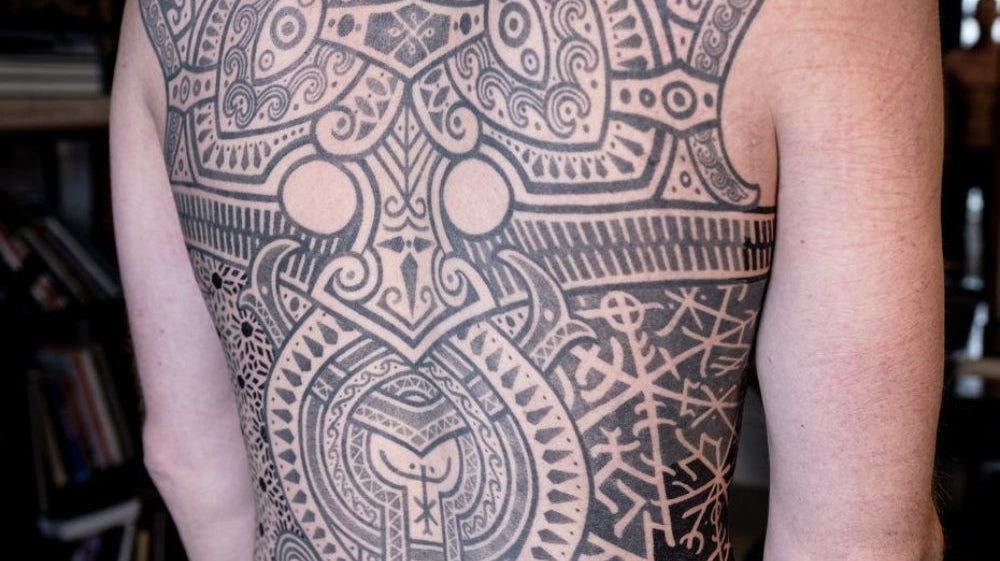
We haven't discussed this in a while, so we're going to do a little refresher. Norse symbols carry weight. Some of that weight is mythic and mysterious, bound to poetry, saga, and archaeology. Some of it, however, is baggage added centuries later by people with very different agendas.
So, what five “Viking” tattoos should you not get (unless informed of their meaning) and why?
Let the list begin! And before you get too agitated, this list is just education and advice. We aren’t telling you what to put on your body; it’s your skin. But before you walk into a tattoo studio asking for a “Viking compass” or a Valknut, it’s worth knowing exactly what you are planning to mark on yourself.
The Valknut

Also known as Hrungnir’s Heart, the Valknut is a three-triangle knot that appears in Viking Age and pre-Viking contexts.

The symbol exists in several forms and has many beautiful examples, such as:
-
The Nene River ring from England
-
The Oseberg grave goods in Norway (bedposts, tapestry fragments, even a decorated bucket lid that inspired our Death Bucket design!)
-
The Lärbro Tängelgårda stones from Gotland (Stone 1 in particular), where the Valknut occurs twice, are clearly related to Óðin and most likely a death and/or burial ritual.
-
The Stora Hammars stone is also from Gotland. Stone 1 holds a panel depicting what looks most like a scene of sacrifice, possibly a blood eagle ritual, with the Valknut depicted right above this interaction.
Because of the places this symbol has been found, someone had the brilliant idea to name it the Death Knot, but it’s a more modern name for it, penned by a history enthusiast in Norway. It is worth noting that most examples of the Valknut pre-date the Viking age, so while it is from an age of epics and sagas, it is not a symbol commonly used on Viking age art.
VALKNUT TATTOO MEANING
We don’t have a written explanation of the Valknut from the Viking Age, only images carved on stones, woven into textiles, or painted on artefacts. Most evidence points to a strong link with Óðin and death: on Gotland’s stones, it hovers above battle and ritual scenes, suggesting his role as a guide of souls. Some scholars, like Hilda Ellis Davidson, interpret it as Óðin’s power to bind or unbind the mind — the frenzy (óðr) he gave warriors and shamans. So, on a spiritual level, a Valknut tattoo can represent embracing mystery, transformation, and the cycles of life and death.
MISUSE AND MODERN PERCEPTION
Unfortunately, the Valknut has been misused in modern times. In the 20th and 21st centuries, far-right groups adopted it alongside other runes as part of their pseudo-Norse branding. They cherry-pick symbols like the Valknut, the Sól rune, and even the Ægishjálmr to give their movements a veneer of “ancient warrior culture.”
For the record, the Valknut is not racist, fascist, or inherently “offensive.” It is an archaeological symbol with strong links to Óðin and the Viking Age. Extremists' misuse of it does not erase its authentic meaning.
Still, if you’re considering a Valknut tattoo, be prepared to explain it. Someone seeing it out of context may assume an association you don’t want. The best armour here is knowledge: know what it truly represents, and be clear that you wear it as a symbol of Norse mythology, not as a symbol of hate.


VEGVÍSIR OR The ‘VIKING COMPASS’

The Vegvísir tattoo — often described as a Viking compass tattoo — is wildly popular. But shockingly enough, this design is not Viking at all. It will not help you find your way to anything (not even Aldi), and it is not a bind rune, as many believe it to be. The design comes from the Huld Manuscript from 1860, and while the idea and even design might be older, this is the oldest attestation we have of it. Its accompanying line reads:
“Ber hann þenna stafi, þá villist hann ekki í stormi né í þoku, og villist ekki þó ókunnugt sé leiðin”.
"If this sign is carried, one will never lose one's way in storms or bad weather, even when the way is not known".
Romantic? Certainly. Historical? Not so much. The Vegvísir meaning is rooted in Icelandic magic traditions (galdrastafir), not Viking navigation. It is worth mentioning that the Vikings were a thing of the past in the 19th century, and the most Viking-like activity experienced at the time by Icelanders was the constant raids by more modern slavers and pirates, who assailed the shores.
VEGVÍSIR TATTOO MEANING
The design has been the source of inspiration for many a bind rune across the world, and there is nothing wrong with this. Just be aware that you are having a sigil from Christian and Judaic magic tattooed on your skin, not a “Viking compass.” For many today, the Vegvísir tattoo meaning is symbolic guidance: a talisman for staying the course through life’s chaos.
MISUSE AND MODERN PERCEPTION
Unlike the Valknut, the Vegvísir hasn’t been strongly co-opted by extremist groups. Instead, its “compass” label has spread through pop culture and Pinterest boards. The biggest misuse here is historical — people get it believing it’s a genuine Viking compass. It isn’t. But unlike some other symbols, you don’t have to worry about it being mistaken for a hate emblem.
THE HELM OF AWE

The Helm of Awe (Ægishjálmr) has slightly stronger Norse ties, though still not Viking Age. It appears in medieval Icelandic grimoires; mentioned in the Fáfnismál, an Eddic Poem from the anonymous collection of Old Norse Myths, the Vǫlsunga saga and Reginsmal.
In the poems, the Helm of Awe is described as a physical item, but the first time this design comes to life is in 1670 in an Icelandic manuscript that has nothing to do with anything Viking. It just got connected over the decades and centuries as a Viking symbol, and people didn’t really check up on the validity of this idea.
HELM OF AWE TATTOO MEANING
In those texts, the Ægishjálmr is a physical object worn for terror and protection — not a drawn stave. It is hard to determine how the concept of the Helm of Awe or Helm of Terror went from a physical object in poetry to a graphical design more bound to the idea of striking fear into one's enemies, but storytelling in one form or another surely plays a part. The graphic design we know today and often used as an Ægishjálmr tattoo is a later invention. We can use it to symbolise strength, fearlessness, and protection.
MISUSE AND MODERN PERCEPTION
As with the Vegvísir, there is nothing wrong at all with getting this one as a tattoo, but it’s always best to know what you are getting etched onto your skin. Just be aware of the idea and history. And of course, remember, it is meant to scare anyone away — hardly the best thing to wear as a human, pack animals that we are!
Is the Helm of Awe racist? No — but like the Valknut, it has occasionally been adopted by extremist groups trying to build an imagined connection to a warrior past. The symbol has been spotted at neo-pagan rallies with white nationalist ties.
That said, its misuse is far less common than the Valknut or the Sól rune. For most people, an Ægishjálmr tattoo will simply be read as a nod to Norse myth or Icelandic magic. Just be aware that, in fringe contexts, some might try to claim it. Don’t let them — knowledge is the antidote.
WEB OF WYRD (SKULDARVEF)

Source: Surflegacy
The so-called Web of Wyrd looks ancient, but it isn’t. The design first surfaced in Jan Fries’ 1993 book Helrunar, a Manual of Rune Magick. For this book, the design is featured twice. The earliest mention of the name we can find is from The Web of Wyrd: Tales of an Anglo-Saxon Sorcerer, by Brian Bates, published in 1984.
All evidence points to this design and concept being a fairly modern idea. That said, the idea behind it is old: fate woven like cloth, threads connecting past, present, and future. Old Norse myths speak of the Nornir weaving destiny at the roots of Yggdrasill.
WEB OF WYRD TATTOO MEANING
The idea behind the Web of Wyrd symbol is that all the runes are present within the weave, and the three times three staves crossing symbolise the branches and roots of Yggdrasil. It is a reminder of destiny, interconnectedness, and the runes woven into life’s fabric.
MISUSE AND MODERN PERCEPTION
So, while this symbol is beautiful in idea, it lacks the tie-in to ancient times. People assume it’s Viking, when it’s actually a late 20th-century invention inspired by older themes — still a worthy tattoo to get. If you get one, know it’s a modern mystical symbol — not an ancient stave.
On another note, Isar found the image somewhat lacking in elegance, so he designed his own beautiful Web of Wyrd, which holds all the runes in one web. Buy the t-shirt:
THE BLACK SUN, OR SONNENRAD

The last of this list, and the very black sheep of this bunch, is the only design we ask you to avoid, as its maker had dark intentions with the creation. It is not a Viking symbol.
It was designed by Heinrich Himmler for the SS during World War II, decorating the floor of his castle at Wewelsburg. Himmler appropriated 12 Sól runes (Sowilo), the same rune used in SS insignia, to form the “Black Sun.”
SONNENRAD TATTOO MEANING
Some people today mistakenly believe the Sonnenrad is an ancient Germanic or Norse sun wheel. It isn’t. It’s a 20th-century invention made by the Nazis. As such, its meaning is inseparable from that context.
The Sonnenrad is now a recognised hate symbol, used by white supremacist and neo-Nazi groups worldwide. Unlike the Valknut or Ægishjálmr, which have older origins that extremists have tried to claim, the Sonnenrad was born from fascism.
There are plenty of authentic solar symbols in Norse and Germanic art worth celebrating and even tattooing, such as sun crosses, swirl sun discs, and radiant wheels linked to the goddess Sól, seen on Gotland picture stones and Migration Period bracteates. These are not “broken” designs, are not associated with fascist movements, and deserve positive attention. But this particular Black Sun is not of ancient origin.
Sadly, many get the Sonnenrad tattooed because they see it on Pinterest and the like, without knowing its origins. As mentioned, there are hundreds of alternatives, so we politely encourage you to avoid this design and choose from the wider selection.
As a palate cleanser from all this ugly stuff, why not treat yourself to a new t-shirt:
OTHER NORSE SYMBOLS MISUSED TODAY
The five symbols above aren’t the only ones that can cause confusion. While many runes and designs are authentic and fascinating, a handful have been hijacked in the modern era. If you’re exploring Norse tattoos, it’s worth being aware of these too:
THE SÓL RUNE (ᛋ) — THE SUN RUNE

Original meaning: Light, the sun, victory.
Misuse: Appropriated by the SS as their insignia, the infamous “lightning bolts.”
Today: Almost universally associated with Nazism. Best avoided as a tattoo, however ancient its real meaning. Bind runes including this symbol would be far less problematic.
THE ODAL RUNE (ᛟ) — THE RUNE OF HERITAGE

Original meaning: Inheritance, property, ancestral land.
Misuse: Used in Nazi Germany and revived by neo-Nazi groups as a “blood and soil” emblem.
Today: Still spotted on extremist banners. Historically innocent, but now heavily politicised.
THE TIWAZ RUNE (ᛏ) — RUNE OF TÝR

Original meaning: Justice, law, self-sacrifice.
Misuse: Sometimes used by extremist groups as a martial “warrior” symbol.
Today: Less poisoned than Sól or Odal, but still occasionally co-opted.
THE WOLFSANGEL (WOLF-HOOK)

Original meaning: The symbol of a medieval European wolf hunting trap, not Viking in origin, and it is not a Norse rune.
Misuse: Used by certain Nazi divisions and later neo-Nazi groups.
Today: Explicitly linked to extremism. If you see it on a banner, it isn’t about medieval hunting or warding off werewolves.
THE SWASTIKA / SUNWHEEL

Original meaning: An ancient solar symbol found across the world, including on Migration Era and Scandinavian artefacts.
Misuse: Co-opted by the Nazi Party into their flag and ideology.
Today: In South Asia, it remains a sacred sign of good fortune, but in the West, it is almost always read as a hate symbol.
THE RAVEN BANNER

Original meaning: Viking leaders were described as carrying raven banners, calling on Óðin’s ravens Huginn and Muninn.
Misuse: Certain far-right groups use stylised raven banners as “Viking warrior” branding.
Today: Authentic historically, but can be misread in modern contexts depending on the style.
We highly recommend you check the Anti-Defamation League Hate Symbols Database before you get anything inked.
READ MORE>> BEGINNERS GUIDE TO NORSE RUNES, SIGILS & BIND RUNES
FAQS ABOUT NORSE TATTOOS AND SYMBOLS
ARE NORSE RUNES SAFE TO GET AS TATTOOS?
Yes, the runes themselves (Elder Futhark and Younger Futhark) are not racist or fascist. They were alphabets, used for everything from gravestones to ownership marks. The misuse happens when extremists cherry-pick runes like Sól or Odal for their propaganda.
If you want to go deeper, consider bind runes — combinations of runes crafted into a single design. A bind rune can layer multiple meanings together (for example, protection + strength + journey), offering far more depth than a single rune. If you’re curious, our rune books go into how these symbols can be combined responsibly.
WHAT ABOUT THOR’S HAMMER (MJǪLLNIR)?
Mjǫllnir has unfortunately been misused by some far-right groups trying to claim it as a badge of “warrior heritage.” But historically, it is one of the most positive and widespread Norse symbols: a protective amulet, a sign of strength, and a blessing. It belongs to the culture, not to extremists. Wearing Mjǫllnir (or tattooing it) is an act of connection with Þórr, the defender of gods and humans — not a political statement.
ARE GODMASKS, ANIMAL MOTIFS, AND MYTHIC FIGURES GOOD TATTOO CHOICES?
Absolutely. Norse art abounds with depictions of godmasks, spiritual animals, and mythic scenes. Masks may represent Óðin, Freyr, or other deities; animals like ravens, wolves, and serpents hold deep mythological weight. These symbols are rich with meaning and are far less likely to be mistaken for extremist emblems.
For inspiration rooted in history rather than internet myths, browse our Nordic tattoo books, which explore designs from archaeological finds and authentic sources.
WHY DO EXTREMISTS KEEP STEALING NORSE SYMBOLS?
Because Norse culture is often romanticised as “warrior heritage, " extremist groups take these symbols to construct a false narrative of racial purity and strength. In reality, Viking Age society was diverse and multicultural and traded widely across Europe, the Middle East, and beyond. Their misuse says more about the ignorance of extremists than about the symbols themselves.
CAN TATTOOS OF NORSE SYMBOLS GET ME IN TROUBLE SOCIALLY?
Sometimes, yes. A Valknut or Ægishjálmr may be read by some as extremist symbols, even though they are not inherently racist. Context matters: if your tattoo comes with knowledge, you can explain its real meaning. The real risk is people assuming intent if they don’t know the history.
IS IT DISRESPECTFUL TO GET A NORSE TATTOO IF I’M NOT SCANDINAVIAN?
Not at all. Symbols from Norse mythology belong to human cultural heritage, not to one nationality. What matters is respect: learn the history, avoid extremist misuses, and don’t treat the culture as “aesthetic wallpaper.” A thoughtful Vegvísir or bind rune tattoo, for example, is far more respectful than a careless Sonnenrad.
DID VIKINGS REALLY HAVE TATTOOS?
We don’t have direct archaeological evidence of Viking tattoos, but Arab chroniclers like Ahmad ibn Fadlan described Norsemen with dark markings across their bodies. So, while we can’t point to an exact Viking tattoo design, it’s plausible that tattoos were part of their culture.
ARE MODERN DESIGNS LIKE THE WEB OF WYRD “FAKE”?
They’re modern, yes — but not necessarily “fake.” The Web of Wyrd draws on genuine Norse concepts of fate and weaving, even if the specific design is 20th-century. Think of it as inspired by Norse myth, rather than authentic Viking Age.
ARE NORSE SYMBOLS ONLY FOR PAGANS OR HEATHENS?
Not at all. You don’t need to practice Ásatrú or Heathenry to wear a Norse symbol respectfully. Many people connect with these designs as heritage, mythology, or art. Just be honest about why you’re wearing it — and avoid co-opting religious meaning you don’t believe in.
RELATED: DISCOVER THE BEST NORDIC TATTOO ARTISTS – OUR TOP PICKS
KNOTS, COMPASSES, AND CONTEXT: CHOOSING SYMBOLS WITH WISDOM
Norse symbols are powerful, layered, and beautiful. But they are also complicated. Some, like the Valknut, whisper of Óðin’s mysteries while also being misused by people with no business wielding them. Others, like the Vegvísir or Ægishjálmr, carry genuine magic — just not Viking Age magic. And then there’s the Sonnenrad, which was never Norse to begin with, and deserves to stay exactly where it came from: on the ash heap of history.
If you want a tattoo that honours the old ways, the safest path is knowledge. Look to the runes, especially as bind runes for personal meaning. Look to Mjǫllnir, godmasks, and the great animals of the myths — wolves, ravens, serpents, and stags. These designs belong to the stories and poetry of the North, not to the shallow theatrics of hate groups.
At Northern Black, our commitment is simple: to reclaim Norse heritage from misuse, and to celebrate it as art, history, and living culture. In the end, tattoos are about stories.
Choose a story that’s truly yours — not one someone else has twisted.
IF YOU WANT INSPIRATION GROUNDED IN ARCHAEOLOGY AND MYTH, OUR NORDIC TATTOO BOOKS AND RUNE BOOKS ARE A GOOD PLACE TO START.
First published: 24 March 2025
Updated: 26 September 2025