
Odin is often introduced as the chief god of the Æsir, the ruler of Asgard, and the figure who presides over war, poetry, and kingship. But that description misses the most important part of who he is.
Odin is not simply a god of power. He is a god of restless curiosity.
Across the Norse sources, Odin appears again and again as a seeker — wandering the worlds in disguise, questioning giants, trading knowledge for sacrifice, and pursuing wisdom wherever it can be found.
This relentless search for understanding leads directly to one of the most famous moments in Norse mythology: the discovery of the runes.
Runes are not just letters. In the early Norse world, they were also seen as symbols of meaning, memory, and, sometimes, magic. The myths surrounding Odin and the runes tell us something important about how knowledge itself was understood in the Viking Age.
To understand Odin’s runes, we first have to understand the god himself.
WHO WAS ODIN?

In Norse mythology, Odin is the chief god of the Æsir, one of the main groups of gods in the Norse cosmology. He is often described as the ruler of Asgard, the realm of the gods, though his authority is not absolute in the way later traditions sometimes portray it.
Odin’s story begins long before the Viking Age itself. According to the mythological accounts preserved in the Poetic Edda and Prose Edda, he was the son of Borr and the giantess Bestla, and the brother of Vili and Vé. Together, the three brothers played a central role in the creation of the world.
The myths describe how they defeated the primordial giant Ymir, whose body was used to form the cosmos. From Ymir’s flesh came the earth, from his blood the seas, from his bones the mountains, and from his skull the sky.
Odin is also closely connected to kingship and ancestry. Many Scandinavian royal lineages claimed descent from him, presenting the god not only as a divine figure but as a distant progenitor of rulers.
About the image: Odin, in his guise as a wanderer, as imagined by Georg von Rosen (1886)
ODIN’S FAMILY
Odin’s wife is Frigg, a goddess associated with foresight, motherhood, and royal authority. She is said to possess knowledge of fate, though the myths often note that she keeps this knowledge to herself.
Odin is also the father of several important gods.
His most famous son is Thor, the thunder god and defender of both gods and humans. Thor’s mother is the giantess Jörð, whose name literally means “earth.”
Another son is Baldr, often described as the most beloved of the gods. Baldr’s death is one of the central tragedies in Norse mythology and plays a significant role in the events leading toward Ragnarök, the prophesied end of the world.
Other sons attributed to Odin include Víðarr, associated with vengeance and survival after Ragnarök, and Váli, who avenges Baldr’s death.
Through these relationships, Odin stands at the centre of the mythological family of the Æsir, linking many of the most important figures in Norse mythology.
Yet despite his position as a ruler and father, the stories rarely portray Odin as a settled or static figure. More often, he appears as a psychopomp, a traveller, scholar, and seeker of hidden knowledge — a god who values wisdom above comfort, and who is willing to sacrifice greatly in pursuit of it. It is this relentless search for understanding that ultimately leads him to the discovery of the runes.
ODIN: THE GOD WHO GAVE UP EVERYTHING FOR KNOWLEDGE
Odin appears throughout the Poetic Edda and Prose Edda as a complicated figure.
He is associated with war and kingship, but also with poetry, prophecy, and hidden knowledge. In many stories, Odin spans the Nine Worlds disguised as an old wanderer — hooded, one-eyed, carrying a spear and a staff.
His missing eye is one of the most well-known symbols of Odin.
According to the myths, Odin sacrificed his eye at Mímir’s well, a source of deep wisdom beneath the roots of Yggdrasil. In exchange, he gained knowledge that few beings could ever hope to possess.
This moment explains something fundamental about Odin’s powers. He does not simply command knowledge. He pays for it.
The pattern repeats throughout the myths: Odin trades, sacrifices, or suffers in order to gain insight. His pursuit of wisdom is relentless — and sometimes dangerous.
The story of the runes is the clearest example of this.
RELATED: HUNG LIKE A GOD: HOW ODIN SACRIFICED HIMSELF IN THE PURSUIT OF KNOWLEDGE
ODIN AND THE DISCOVERY OF THE RUNES
The story of how Odin gained the runes comes from Hávamál, often translated as The Sayings of the High One. In one section — sometimes called Odin’s Rune Song — the god describes sacrificing himself to himself.
He hangs for nine nights on the world tree Yggdrasil, wounded by his own spear and denied food and drink. Only after this ordeal do the runes reveal themselves.
The passage reads almost like a memory:
“I know that I hung on a wind-rocked tree, nine whole nights, with a spear wounded, and to Odin offered, myself to myself; on that tree, of which no one knows from what root it springs. Bread no one gave me, nor a horn of drink, downward I peered, to runes applied myself, wailing learnt them, then fell down thence.”
(Benjamin Thorpe translation)
When the runes finally appear, Odin does not create them. He discovers them.
This distinction matters. In the mythic worldview of the Norse sources, the runes are not inventions. They are hidden patterns within the structure of the world, waiting to be understood.
Odin’s sacrifice allows him to perceive them — and to teach them. This story is the foundation of the idea that Odin’s runes carry power.
For readers interested in studying runes more seriously, the best approach is to start with resources that explore both the historical origins of the runic alphabet and its later interpretations.
One accessible introduction to the subject is:
Books like this help bridge the gap between mythology, linguistic history, and the many modern interpretations of runic symbolism.
THE ANSUZ RUNE: THE RUNE MOST OFTEN LINKED TO ODIN

Among the runes of the Elder Futhark, the rune most commonly connected to Odin is Ansuz.
The name likely derives from the Proto-Germanic word “ansuz”, meaning “god” or “one of the Æsir”.
Because Odin is the primary among the Æsir, the rune gradually became associated with him in later interpretations.
ANSUZ RUNE MEANING
Traditionally, the Ansuz rune meaning is linked to:
-
Speech and communication
-
Divine inspiration
-
Wisdom and knowledge
-
Poetry and storytelling.
These themes align closely with Odin’s domains. He is not only a war god but also the god of poetry, credited with bringing the mead of poetry into the world.
However, it is important to note something often misunderstood in modern rune culture.
There is no single confirmed “Odin rune.”
Runes were primarily an alphabet used for writing. Although certain markings might have had magical or symbolic value, the idea that each rune is solely associated with a particular god is mostly a modern interpretation. Still, the association between Ansuz and Odin has remained strong because it reflects the broader themes of the mythology.
About the image: The Ansuz rune from The Elder Futhark Runes Book & Cards, illustrated by Galaxara or buy the print Ansuz Rune Print – Mighty Tales of The North
ODIN’S SYMBOLS IN NORSE CULTURE
While there may not be a single definitive symbol for Odin, several motifs appear repeatedly in Norse mythology, archaeological finds, and later artistic interpretations.
These Odin symbols were not used as simple emblems in the way modern logos are. Instead, they appear within carvings, grave markers, and mythological imagery that reflect the stories and beliefs surrounding the god.
Over time, these motifs have become closely associated with Odin and are often used today in artwork, jewellery, and Odin tattoo design.
THE VALKNUT

One of the most recognisable symbols linked to Odin is the Valknut, a motif made of three interlocking triangles.
The Valknut appears on several Viking Age artefacts, including picture stones from Gotland and burial-related imagery. Because it is frequently found in scenes that appear to involve warriors, death, or ritual activity, many scholars believe it has connections to the afterlife.
This is why the Valknut is often associated with Odin and the fallen warriors of Valhalla. Odin was believed to choose half of those slain in battle, bringing them to Valhalla, while the goddess Freyja received the other half in Fólkvangr.
Despite its popularity today, the precise meaning of the Valknut remains debated. Like many symbols from the Viking Age, its significance likely depended on context and storytelling rather than a single fixed interpretation.
RELATED: VIKING BURIALS AND THE AFTERLIFE IN NORSE MYTHOLOGY
GUNGNIR
Gungnir, Odin’s spear, is one of the clearest symbols of his authority.
Forged by dwarves known as the Sons of Ivaldi under the mastery of the blacksmith dwarf Dvalinn, according to the Prose Edda, Gungnir was said never to miss its mark once thrown. In the stories, it represents both divine power and ritual authority. Odin himself throws the spear to begin battles, symbolically dedicating warriors to himself.
Spears also held an important place in Norse culture more broadly. Archaeological finds show they were not only practical weapons but could carry ritual significance, especially in burial contexts. In Sigrdrífumál, the valkyrie Sigrdrífa offers Sigurd guidance on the magical use of runes. Among the details she shares is the idea that runes were carved onto the tip of Gungnir.
HUGINN AND MUNINN

Odin’s ravens — Huginn and Muninn — are among the most distinctive elements of his mythology.
Their names are usually translated as “thought” and “memory.” Each day they fly across the worlds and return to Odin with news of what they have seen.
The ravens reinforce a central theme of Odin’s character: a god constantly seeking knowledge. They are not simply companions but extensions of his awareness, bringing information from across the Nine Worlds.
Ravens themselves were powerful symbols in the Viking Age. They appear in battle imagery, mythological scenes, and even on banners associated with Norse warriors.
GERI AND FREKI

Odin is also accompanied by two wolves named Geri and Freki, whose names are often translated as “the greedy one” and “the ravenous one.”
They appear in descriptions of Valhalla, where Odin sits among the slain warriors of the hall. According to the sources, Odin gives all the meat placed before him to the wolves, sustaining himself only on wine.
While Huginn and Muninn represent thought and memory, Geri and Freki reflect Odin’s connection to the harsher realities of the world — battle, survival, and the wild forces that exist beyond human control.
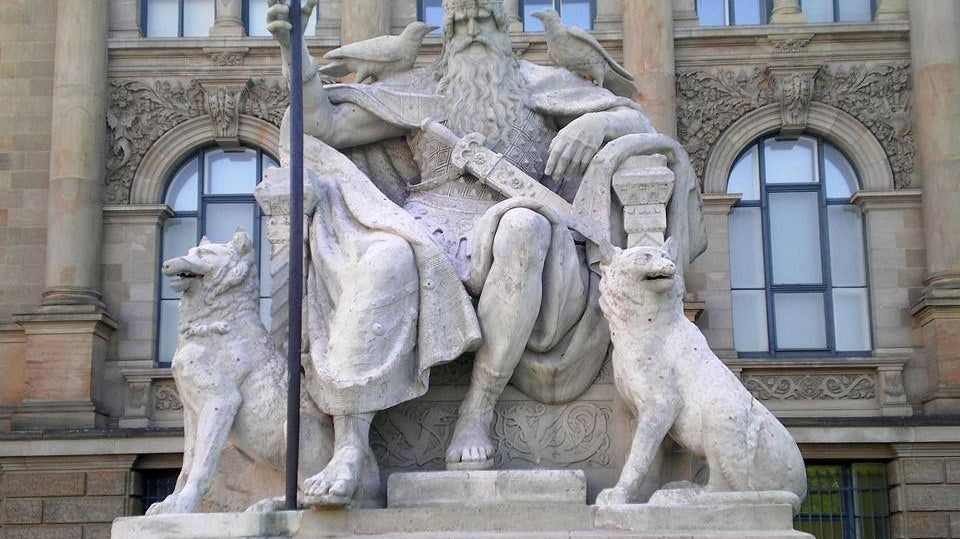
Wolves held a powerful symbolic place in Norse culture. They appear in both protective and destructive roles throughout the myths, from Odin’s companions to the monstrous wolf Fenrir, whose fate is tied to the events of Ragnarök.
Like many symbols associated with Odin, Geri and Freki reinforce the idea that he is a god who stands between civilisation and the untamed world, gathering knowledge from both.
ODIN’S EYE
Perhaps the most striking symbolic image connected to Odin is his missing eye.
According to the myths, Odin sacrificed one of his eyes at Mímir’s well in exchange for wisdom. The well lay beneath one of the roots of Yggdrasil and was guarded by the being Mímir, who possessed deep knowledge.
The story reinforces a recurring theme in the mythology: wisdom always comes at a cost.
In modern artwork and tattoo design, Odin’s eye is sometimes used as a symbolic reference to this sacrifice, conveying the idea that understanding the deeper truths of the world often requires giving something up in return.
ODIN AND MÍMIR’S HEAD

Mímir was renowned for his deep wisdom. He was associated with Mímir’s well, a source of knowledge located beneath the roots of the world tree.
During the war between the Æsir and the Vanir, Mímir was sent to the Vanir as a hostage along with the god Hœnir. When the Vanir suspected they had been deceived in the arrangement, they executed Mímir and sent his severed head back to the Æsir.
Odin did not allow Mímir's knowledge to be lost. Instead, the myths say that Odin preserved the head using herbs and magic, preventing it from decaying. After this, he kept Mímir’s head with him and consulted it for counsel and hidden knowledge.
The story reinforces a recurring theme in Odin’s mythology: he gathers wisdom from unusual and sometimes unsettling sources. Whether sacrificing his eye, hanging from Yggdrasil to discover the runes, or preserving Mímir’s head, Odin’s pursuit of knowledge is relentless.
Because of this story, Mímir’s head sometimes appears in artistic depictions of Odin, particularly in later illustrations and modern interpretations of Norse mythology. However, it is not as widely used as symbols like the ravens, spear, or Valknut.
Although Odin himself is rarely labelled directly in Viking Age artefacts, several archaeological finds are widely believed to depict him. One often-cited example is the Tängelgårda stone from Gotland, which shows a mounted warrior approaching a figure holding a spear, sometimes interpreted as Odin welcoming the dead to Valhalla.
Another possible depiction appears on the Oseberg tapestry fragments, where spear-bearing figures and processional scenes may reference mythological narratives. While interpretations remain debated among scholars, these artefacts show how myth, symbolism, and storytelling were woven into Norse visual culture, leaving clues about how figures like Odin may have been imagined during the Viking Age.
ODIN RUNES, NORSE MAGIC SYMBOLS, AND MODERN INTERPRETATIONS
Modern discussions about Norse magic symbols often mix historical evidence with later folklore and modern interpretation.
Runes certainly appear in contexts suggesting ritual use — particularly in sagas describing charms, curses, or healing spells. However, the surviving evidence is limited and often ambiguous.
What we can say with confidence is that runes were treated with serious respect.
They were tools of writing, markers of identity, memorials for the dead, and occasionally instruments of ritual practice.
The myth of Odin discovering the runes reinforces the idea that knowledge itself carries power. This is likely why runes remain so compelling today.
For those interested in exploring the Elder Futhark runes in a more hands-on way, studying them as a complete system is often more useful than focusing on a single rune.
Resources that combine the runes with explanations and historical context can make this process far easier.
Sets like this allow readers to explore the full alphabet while learning how the runes were traditionally understood.
ODIN RUNE TATTOOS AND THE IMPORTANCE OF UNDERSTANDING THE SYMBOLS
In modern culture, runes frequently appear in Odin rune tattoo designs and Norse-inspired artwork. But choosing a rune purely for aesthetics misses the deeper context behind these symbols.
Runes were part of a living writing system used for centuries across Scandinavia and northern Europe. Each mark represented sound, language, and meaning.
For those interested in Odin tattoo design, the most meaningful approach is usually the simplest:
Take time to understand the rune you choose.
Explore its linguistic roots, its historical use, and the mythology surrounding it. When viewed this way, a rune symbol for Odin becomes more than decoration — it becomes a connection to a much older tradition of storytelling and symbolism.
GO DEEPER: LEARNING MORE ABOUT ODIN AND THE RUNES
The mythology of Odin and the runes opens the door to a much wider world of Norse history, language, and symbolism.
If this subject interests you, the best next step is to explore the sources themselves.
The Poetic Edda, particularly Hávamál, offers the most direct insight into Odin’s rune song and the values surrounding wisdom, sacrifice, and knowledge in Norse culture.
Runic inscriptions, archaeological finds, and historical texts continue to shape our understanding of how these symbols were used and understood.
For those who want to explore the visual culture surrounding these stories, Viking Age art offers another fascinating perspective. Carvings, metalwork, and stone monuments reveal how symbols, animals, and mythological figures were represented across the Norse world.
A particularly detailed resource on this subject is:
Books like this help place runes, symbols, and mythological imagery within the broader artistic traditions of the Viking Age.
The runes were never meant to be mysterious decorations.
They were a language, a record, and sometimes a key to understanding the world — just as Odin discovered when he first saw them beneath the branches of Yggdrasil.
A WINK TO ODIN
Odin is often described as a nomad — a god who travels the nine worlds in search of knowledge. Sometimes the best way to honour that spirit is simply to keep learning. And occasionally, to have a little fun with the mythology along the way.
Odin is not an easy figure, and that is precisely why he’s still so respected and revered today. He is a reminder to stay curious, question what we think we know and accept that understanding takes time — and sometimes comes at a cost.
He reflects a way of moving through the world that values depth over noise, thought over reaction, and learning over certainty. And that, more than anything else, is what has kept his story alive.
EXPLORE OUR BOOKS, APPAREL, HOMEWARE AND RUNES ROOTED IN NORSE TRADITION — DESIGNED WITH RESPECT FOR THE PAST.