
Twice a year, the balance shifts.
At the spring equinox, day and night stand equal. The long dark has loosened its grip, and the light begins to win. This is Ostara — a festival of renewal, fertility, and quiet transformation. It is not a loud celebration. Not yet.
Ostara belongs to thresholds — the moment before growth becomes undeniable. Seeds beneath the soil. Lambs not yet born. The first green shoots pushing through cold ground.
This is where the year begins to breathe again. In fact, it feels more like the new year than the New Year.
WHAT IS OSTARA?
Ostara is the modern Pagan name for the spring equinox festival, typically falling around March 20–21 in the Northern Hemisphere.
It sits within the Wheel of the Year, marking the midpoint between winter and summer — a hinge between stillness and growth.
In contemporary Pagan practice (especially Wicca and Druidry), Ostara represents:
-
Balance (equal light and dark)
-
Fertility and new life
-
Renewal and beginnings
-
The awakening of the land
But historically, things are less straightforward.
Unlike festivals such as Yule or Samhain, Ostara’s ancient roots are debated — and that ambiguity is part of what makes it interesting.
WAS OSTARA EVER A FESTIVAL?
The name Ostara feels ancient. It sounds like it should sit alongside Yule or Samhain — something well-attested, well-documented, deeply rooted.
But when you strip it back, the foundation is surprisingly narrow. The entire idea begins with Bede, an 8th-century Northumbrian monk.
In De Temporum Ratione (The Reckoning of Time), Bede lists the old Anglo-Saxon months and notes that one of them — Ēosturmōnaþ — was named after a goddess called Eostre. He adds, briefly, that feasts were once held in her honour.

Berlin MS Phill. 1832, fol. 27r: end of chapter 15 of Bede, de ratione temporum, with mention of Eosturmonath
Centuries later, Jacob Grimm — better known for collecting folklore — revisited Bede’s account.
Grimm never claimed he’d uncovered a lost goddess in any literal sense — nothing dug from the ground, no shrine, no clear line of worship preserved intact. What he did was piece something together from what little remained. It’s careful work, but it’s still a kind of reaching — trying to bridge gaps where the record has gone quiet.
Grimm inferred from Bede's brief reference that Eostre may have formerly been a part of a larger Germanic tradition associated with the arrival of dawn and the gradual restoration of light after winter. From that perspective, the symbols we now associate with spring — eggs, hares, and the feeling of life returning — begin to seem less arbitrary. They look like part of an older way of understanding the season, something people recognised without needing to spell it out.
But it’s important to be clear about what this is — and what it isn’t. Grimm wasn’t working from new archaeological finds. There are no temples dedicated to her, no detailed rites preserved anywhere. What he had were scraps of folklore that had persisted even as their original meaning faded, similarities with local mythologies, and the way some words bent toward thoughts of the east and sunrise. When combined, it creates something that seems logical and even convincing in certain places, but it is still an interpretation rather than solid proof.
SPRING ACROSS CULTURES: A SHARED INSTINCT
Long before written calendars, before formal religion, before myth was recorded — people noticed the same thing: The world always turns.
And across cultures, separated by distance and language, humans responded in remarkably similar ways.
NOWRUZ: RENEWAL AS ORDER RESTORED
One of the clearest surviving examples is Nowruz, the Persian New Year.
Celebrated for over 3,000 years, Nowruz aligns directly with the spring equinox and centres on:
-
Cleansing (homes are cleaned, old things cleared away)
-
Preparation (tables are set with symbolic items — growth, health, prosperity)
-
Renewal (a conscious reset of the year ahead).
It reflects a worldview in which spring is not just seasonal but cosmic — a restoration of balance and order.
Different culture. Same instinct.
EUROPE: FERTILITY, SURVIVAL, AND THE LAND
Across pre-Christian Europe, spring was less about abstraction and more about urgency.
After winter, food stores were low, livestock were vulnerable and the success of the next harvest was uncertain.
So early spring traditions often focused on:
-
Fertility rites — encouraging growth in crops, animals, and people
-
Field blessings — ritual acts to ensure a successful planting season
-
Seasonal feasting — marking the end of scarcity.
These weren’t symbolic gestures. They were attempts — spiritual or practical — to influence survival.
THE CHRISTIAN LAYER: ADOPTION, NOT REPLACEMENT
When Christianity arrived in Europe, the pastors knew well not to try to rip the old ways from the people. The rhythms of the land were already there, deeply set, and folk weren’t about to abandon them. So rather than trying to erase those patterns, the new faith settled itself around them.
Easter falls at the same turning point in the year, determined by the spring equinox and the phases of the moon. Its central idea — death giving way to life — mirrors what is happening outside, whether you name it or not. And the symbols that gather around it — eggs, lambs, fresh flowers — were not invented in isolation. They were already part of how people understood this season.
So what happened, more often than not, was not replacement but reshaping. Older seasonal customs remained, but their meanings were shifted, recast, and carried forward under a different name.
SYMBOLS OF OSTARA

What’s striking is not just that cultures marked spring — it’s that they reached for the same symbols, again and again.
Not because they shared a single origin, but because they were responding to the same conditions.
EGGS → LIFE BEFORE IT EXISTS
Eggs are one of the oldest spring symbols we have, and they appear far beyond any single culture.
In ancient Persia, eggs were part of Nowruz celebrations, symbolising creation and renewal. In Ukraine, decorated eggs — later known as pysanky — carried protective and fertility meanings long before they were absorbed into Christian Easter traditions.
What makes the egg so powerful is its certainty.
You don’t see life yet — but you know it’s there. Contained. Waiting. Inevitable.
For people coming out of winter, that mattered. Early spring doesn’t look like abundance. Fields are still bare. Trees are only just waking. But the process has already begun beneath the surface.
HARES → FERTILITY WITHOUT RESTRAINT
Hares (and later rabbits) are often softened into something gentle and symbolic, but historically, they weren’t subtle creatures.
They were noticed because they were everywhere in spring.
-
Highly active during mating season
-
Producing multiple litters
-
Visible in open fields, even in daylight.
To early agricultural communities, this wasn’t metaphor — it was observation.
Hares became linked to fertility simply because they embodied it so clearly. And because of their cyclical patterns and nighttime activity, they were also tied to the moon in certain European folklore, though this connection is more interpretive than firmly evidenced.
The later idea of a hare or rabbit associated with eggs (and eventually the Easter Bunny) appears much later in German folklore — not in early pagan sources — but it likely grew from combining two already powerful spring symbols.
SEEDS AND SOIL — THE WORK YOU DON’T SEE
If eggs represent contained life, seeds represent buried potential. And unlike eggs, seeds are part of direct human survival.
For early societies, spring wasn’t just observed — it required action:
-
Fields had to be prepared
-
Seeds had to be planted at the right time
-
The success of the entire year depended on it.
There’s a quiet tension in this symbol. You place something valuable into the ground — and then you wait. You can’t control what happens next.
FLOWERS → BEAUTY THAT DOESN’T LAST
Spring flowers arrive quickly — and disappear just as fast. They are not symbols of permanence.
They represent:
-
Fragility
-
Timing
-
The fleeting nature of growth.
A reminder that the window for action — planting, preparation, survival — is limited.
Yet, while the flowers of spring don’t bloom for long, they herald the arrival of longer, warmer days in a way that is still visceral today. While we don’t rely on seasonal changes for survival quite like we used to, when we see the first snowdrops, crocus and daffodils raise their pretty heads, we breathe a collective sigh of relief and joy.
LIGHT AND BALANCE → A TURNING POINT
The equinox is about as clear-cut as it gets. Day and night come into balance, if only briefly, before the year starts leaning properly into the light again. You don’t need a calendar to notice it. The mornings arrive earlier, the evenings stretch a little further, and there’s a shift in the air that’s hard to pin down but easy to feel.
People have been paying attention to that kind of change for a long time. You see it in the way certain sites are aligned to the sun — standing stones, early monuments — not always with clear explanations, but enough to suggest that these moments mattered.
What the equinox really marks, though, is a turning point. It’s not quite winter anymore, but it’s not the full push of spring either. It sits in between — a point where things start to move in a different direction. And that’s where its weight comes from. Not as a celebration of what’s already here, but as a recognition that something has shifted, and it’s not going back.
RELATED: MABON: REFLECTING ON THE AUTUMN EQUINOX AND THE BALANCE OF LIGHT AND DARK
OSTARA AND NORSE TRADITION: WHAT ACTUALLY CONNECTS?

This is where things require a careful hand.
There is no direct Norse festival called Ostara recorded in the surviving sources. But that does not mean the equinox passed unnoticed.
SEASONAL AWARENESS IN NORSE LIFE
The Norse world was bound to the seasons in a way that’s easy to overlook now. This wasn’t a matter of symbolism or neatly marked festivals — it was survival, plain and simple. Farming determined whether you lived well or struggled through the year. The length of the day shaped how much could be done, how far you could travel, and how long you could work. Seasonal change wasn’t something to reflect on from a distance; it dictated the rhythm of daily life.
When spring began to show, it meant the worst of scarcity was easing. The ground, frozen for months, began to soften enough to work again. Routes that had been cut off by winter slowly reopened, and with them came movement — trade, travel, contact with the wider world. Even if the equinox itself weren’t marked out as a formal ritual date in the surviving sources, the shift it represents would have been felt clearly. It signalled a turning point, one that mattered whether it was named or not.
POSSIBLE MYTHOLOGICAL PARALLELS
Rather than trying to pin Ostara onto the Norse world as if it must have existed there under another name, it makes more sense to step back and look at the broader patterns in Norse cosmology. The sources don’t give us a clean, labelled spring festival — but they do give us something more revealing: a worldview where growth, fertility, and seasonal return are woven into the nature of the gods themselves.
FREYA AND FERTILITY
The goddess Freya is not a “spring goddess” in any narrow sense, but her influence sits firmly within that space. What she governs — desire, fertility, the pull that brings things into being — isn’t something you can neatly box into a season, but you feel it most clearly when the world starts waking up again. It runs through everything: people, animals, the land itself. There’s nothing restrained about Freya’s domain. It’s instinctive, alive, and often unpredictable — the same underlying force you feel when the season begins to turn and everything starts pushing forward again.
That energy has always found its way into how she’s been depicted — not just in older sources, but in how she continues to be interpreted now. Designs like those on the Freya Godmask High Neck Crop draw on that same presence, capturing something of her intensity and independence rather than softening it into something decorative.
FREYR AND THE RETURNING EARTH
Her brother Freyr takes that same force and roots it firmly in the physical world. Where Freya moves through desire and change, Freyr is about what actually grows — the fields, the harvest. He’s tied to the land in a very direct way. If the crops come in, people eat. If they don’t, nothing else really matters.
Later sources mention offerings made to him for good seasons, but it doesn’t read like distant ritual or symbolism. It feels practical. You honour the god who governs the things you depend on. There’s nothing abstract about it. Freyr’s role is grounded in the reality of survival — in whether the land gives back what you need it to.


Together, they form something close to a complete picture of what spring represents in a Norse context — not as a named festival, but as a turning point expressed through the forces they embody.
THE CYCLE OF DEATH AND RENEWAL
Norse cosmology is not linear.
It is cyclical.
-
Winter gives way to spring
-
Life rises, falls, and rises again
-
Even Ragnarök ends in renewal.
This worldview aligns naturally with equinox symbolism, even without a named festival.
RELATED: FREYA: LADY OF LOVE, WAR, AND A PAIR OF CATS
RUNES THAT ALIGN WITH OSTARA THEMES
ᛒ — BERKANO (BIRCH)
Berkano is probably the closest thing to an “Ostara rune,” even if that connection is modern.
-
Named after the birch tree, one of the first to leaf in spring
-
Associated with birth, growth, renewal, and new beginnings
-
Linked to feminine energy, nurturing, and protection.
In early Northern Europe, birch trees were tied to regeneration and fresh starts, often used in purification rites and seasonal transitions.
If you were to choose one rune that feels like early spring, this is it.
ᛃ — JERA (YEAR / HARVEST CYCLE)
Jera represents the cycle of the year — the turning of seasons and the idea that effort leads to eventual reward.
-
Symbolises cycles, timing, and natural progression
-
Closely tied to agriculture and seasonal rhythm
-
Implies that what is planted now will return later.
Jera isn’t about sudden change. It’s about process.
That makes it a strong match for Ostara, which sits right at the point where the cycle begins again.
ᛇ — EIHWAZ (YEW / ENDURANCE AND TRANSITION)
Eihwaz is a more subtle fit.
-
Associated with the yew tree, linked to death and rebirth
-
Represents transformation, endurance, and transition between states
-
Often seen as a threshold rune.
This connects to Ostara more deeply — not the visible growth, but the shift between winter and spring.
It’s the moment before things fully change.
ᛚ — LAGUZ (WATER / FLOW)
Laguz represents water, flow, and life force.
-
Tied to intuition, movement, and natural rhythms
-
It can reflect snowmelt, rivers rising, and the return of movement in the land.
In early spring, water returns first:
-
Ice melts
-
Ground softens
-
Life begins to move again.
Laguz captures that sense of release and flow after stillness.
RUNES IN HISTORY VS MODERN PRACTICE
There’s no evidence that the Norse, or other Germanic peoples, assigned specific runes to the spring equinox or treated them as part of a fixed seasonal calendar. Runes had their own roles — they were used for writing, for marking objects, for carving meaning into things, and sometimes for what we might call magical or symbolic purposes — but not in the structured, wheel-like system you see in modern Pagan practice.
What we’re doing here is something different.
We’re looking at what the runes represent and noticing where those meanings naturally align with the season — growth, cycles, transition, the slow return of life. It’s less about reconstructing an exact historical practice, and more about recognising patterns that feel consistent with both the symbols and the time of year.
That doesn’t make it false. But it does mean it should be approached honestly — as interpretation, not evidence.
Runes are not something you understand all at once. They become clearer through use — handled, turned over, sat with.
If you’re looking to work with them properly, the 24 Elder Futhark Runes Book, Cloth and Cards gives you the full set alongside a guide and cloth, so you can approach them as they were meant to be approached — directly, and without complication.
HOW OSTARA IS CELEBRATED TODAY

Modern Pagan practice tends to be quiet, intentional, and personal.
Common ways people mark Ostara include:
-
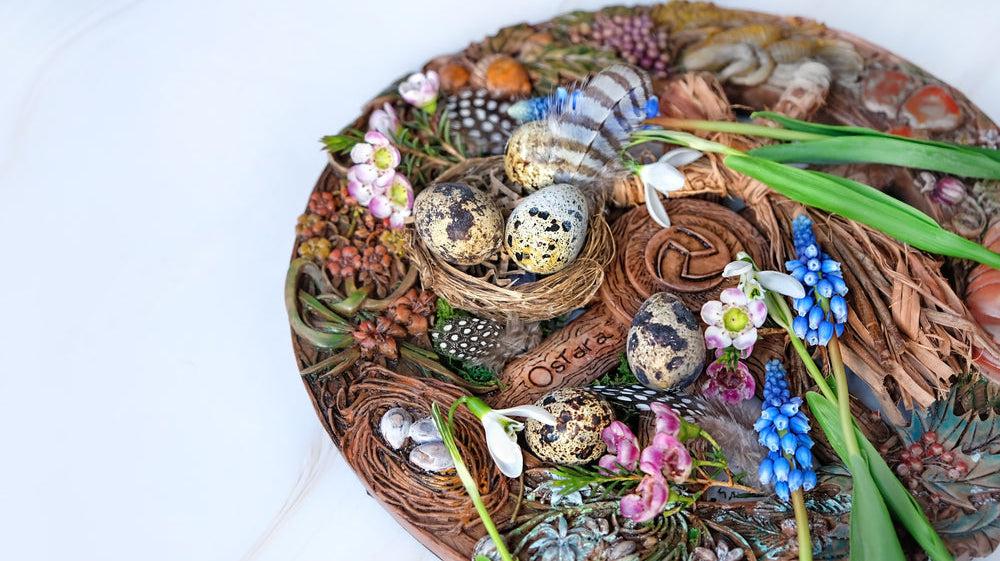
Creating seasonal altars with eggs, flowers, and greenery
-
Planting seeds (literal or symbolic)
-
Lighting candles at sunrise or sunset
-
Spending time outdoors, observing the shift in the land.
It is less about spectacle, more about alignment. You don’t celebrate Ostara by forcing growth. You notice it.
SIMPLE OSTARA RUNE RITUALS
If you were to mark the turning of spring with the runes, there are a few grounded ways to do it:
1. HOLD A SINGLE RUNE
Take one rune — whichever feels most relevant — and sit with it for a few minutes.
No need to “activate” it or assign anything dramatic to it.
Just hold it. Look at it. Let it settle.
This isn’t about manifesting something into existence. It’s about paying attention. You sit with it long enough for its meaning to settle, and in doing so, you start to notice where that same pattern is already showing up in your life. At this time of year especially, it’s less about forcing a beginning and more about recognising one — and deciding whether to move with it.
2. SET AN INTENTION
If you want to go a step further, you can pair a rune with something simple and physical.
-
Press ᛒ Berkano into the soil or place it beside planted seeds
-
Keep ᛃ Jera somewhere visible as a reminder of slow, steady progress and that patience will reward you.
-
Carry ᛇ Eihwaz if you’re navigating change or going through something that's making you feel unsettled; it can help you feel steady.
-
Place ᛚ Laguz near water, or simply hold it while walking near a river or rain.
The point isn’t control; it’s alignment.
3. A QUIET RUNE CASTING
If you already work with rune casting, Ostara can actually be a strong time to go a little deeper with it. You’re standing at the start of a new cycle, so it makes sense to look at more than just a single thread.
You might lay out a small spread — three, five, even more runes if that’s your usual way — and read it in terms of what’s unfolding over the coming season. Not just what is, but what’s building.
The questions can open up a bit here:
-
What is beginning to take shape?
-
Where should energy be directed now?
-
What will grow if it’s given the right conditions?
-
What needs to be left behind with winter?
Ostara isn’t only about noticing — it’s also about setting things in motion. A fuller cast lets you see how those pieces fit together, where things are already moving, and where you still have some say in the outcome.
If you’re drawn more toward reading runes than simply sitting with them, having a complete setup makes that process easier to return to consistently.
The Rune Reader Bundle brings everything together in one place — runes, guidance, and the tools needed for casting — so you can approach it as an ongoing practice rather than something occasional. Especially at a point in the year like Ostara, where things are beginning to shift, it gives you a way to check in more regularly and see how those patterns are unfolding.
SPRING IS STIRRING
Ostara doesn’t need to be reconstructed perfectly to matter.
The older traditions didn’t survive because they were written down neatly. They survived because they were tied to something real. People noticed the change in the air, the land, the light, and they responded to it in whatever way made sense for where they were.
That hasn’t changed.
So take some time to notice the stirrings of spring: lighter evenings, flowers blooming, birds nesting, even the joys of the pollen count rising. They all convey that we made it through another winter, and that is a blessing.
EXPLORE OUR BOOKS, APPAREL, HOMEWARE AND RUNES ROOTED IN NORSE TRADITION — DESIGNED WITH RESPECT FOR THE PAST.